We sometimes wonder down here how much people elsewhere assume things must be getting back to normal in New Orleans. If they do assume that, I suppose it's understandable. The various news media are set up to report on what's happening, and when the big story is on what is not happening -- as is the case in New Orleans, where the issue is all the things that should have happened by now but didn't -- well, the media just aren't that good at letting people know.
So sometimes the local folks just have to do it themselves. And thanks to the internet, you can see it. Link to here and press the play button.
Just for perspective, I used to shop at the hardware store he's walking in front of, and I liked to eat lunch in that Chinese restaurant whenever I was in Mid-City at mid-day. Not great Chinese food, as there is none in New Orleans, but nice people, a nice atmosphere, very pleasant. The loss of these places is not hypothetical to me, not at all.
Sunday, June 04, 2006


Wednesday, May 17, 2006
Disaster Timeline
The New Orleans Times-Picayune, which has risen magnificently to the occasion ever since the storm, now has posted a fascinating animated graphic about the first few hours of the disaster. It's astonishing how rapidly everything happened. As the animation proceeds, watch the clock in the lower left corner. All of the critical levee overtoppings and breaches occurred within four hours. It took the flood waters over a day to reach their fullest extent and depth, but by 10:30 am on August 29, the city's fate was sealed. Link is here.
Note that the legend at the bottom of the page has a symbol, a jagged red dot, clearly indicating where levees were breached. Breached, not overtopped by high water, but where the structures crumbled and failed. What's striking is that there are so many of these failures, widespread throughout the area. These levees, and especially the 17th Avenue and London Avenue floodwalls, were supposed to stand up to a category three hurricane, which is what Katrina was by the time it got here, strongly suggesting system-wide failures of design and construction.
Like everyone else here, I know who I hold responsible: The Army Corps of Engineers. Since the storm, the T-P has been running a series of investigative reports about the Corpse and the levees it designed and built, and it gets worse with each story. For example, when they were designing those floodwalls in the mid-80s, they were basing their designs on elevation maps published in the 1950s, even though everyone knew there had been subsidence in the area since then, and that designs based on those land elevation figures would be faulty. Seems the Corpse didn't much care.
It continues to this day. They kept telling us that by the start of hurricane season they would restore flood protection in critical areas, the areas affected by levee breaches, to pre-Katrina levels. Uh, well, everyone says, since that clearly wasn't enough, couldn't we maybe aim to do a little better? Nunh-unh, says the Corpse, we can't do that because we're not authorized to do that. They seem determined to hide behind that word, "authorized." When you ask why they didn't revise the plans and build higher in the 80s and 90s when subsidence indicated the need, they reply, no, we can't do that, we weren't authorized to do that. Authorized by whom? By legislation mandating better flood protection for New Orleans that was passed by Congress in the aftermath of Hurricane Betsy in 1965. They want us to believe that in thirty years they couldn't go back to Congress and ask for an update to meet changing needs? And these are the people we're counting on to save our skins this season?
By the way, the Corpse now admits that it will not make that deadline for restoring flood protection. Absolutely nobody is surprised.
Note that the legend at the bottom of the page has a symbol, a jagged red dot, clearly indicating where levees were breached. Breached, not overtopped by high water, but where the structures crumbled and failed. What's striking is that there are so many of these failures, widespread throughout the area. These levees, and especially the 17th Avenue and London Avenue floodwalls, were supposed to stand up to a category three hurricane, which is what Katrina was by the time it got here, strongly suggesting system-wide failures of design and construction.
Like everyone else here, I know who I hold responsible: The Army Corps of Engineers. Since the storm, the T-P has been running a series of investigative reports about the Corpse and the levees it designed and built, and it gets worse with each story. For example, when they were designing those floodwalls in the mid-80s, they were basing their designs on elevation maps published in the 1950s, even though everyone knew there had been subsidence in the area since then, and that designs based on those land elevation figures would be faulty. Seems the Corpse didn't much care.
It continues to this day. They kept telling us that by the start of hurricane season they would restore flood protection in critical areas, the areas affected by levee breaches, to pre-Katrina levels. Uh, well, everyone says, since that clearly wasn't enough, couldn't we maybe aim to do a little better? Nunh-unh, says the Corpse, we can't do that because we're not authorized to do that. They seem determined to hide behind that word, "authorized." When you ask why they didn't revise the plans and build higher in the 80s and 90s when subsidence indicated the need, they reply, no, we can't do that, we weren't authorized to do that. Authorized by whom? By legislation mandating better flood protection for New Orleans that was passed by Congress in the aftermath of Hurricane Betsy in 1965. They want us to believe that in thirty years they couldn't go back to Congress and ask for an update to meet changing needs? And these are the people we're counting on to save our skins this season?
By the way, the Corpse now admits that it will not make that deadline for restoring flood protection. Absolutely nobody is surprised.
Thursday, April 20, 2006
Monday, April 17, 2006
Nukes to the Rescue
For decades the position of the environmental movement towards nuclear power has been clear: over our dead bodies. (And please recycle them.) But according to this editorial in the Washington Post, some of the leading figures in the movement may be coming to their senses.
The greens always said, nuclear power plants are too dangerous!! My thought always was, compared with what? Given that American nuclear plants have a perfect safety record, the millions of tons of CO2 that coal fired plants turn out annually is a much greater hazard. As worries mount about the danger of catastrophic climate change, many who thought differently are coming to agree.
We'll never get rid of fossil fuels entirely, of course. When you need to combine efficient power production with mobility, as with cars and planes, petrofuels are the only real choice. But the plants that supply the power grid don't have to go anywhere. If nuclear plants can do the job economically and efficiently and without doing the environmental damage that burning coal does, why not build more of them?
The greens always said, nuclear power plants are too dangerous!! My thought always was, compared with what? Given that American nuclear plants have a perfect safety record, the millions of tons of CO2 that coal fired plants turn out annually is a much greater hazard. As worries mount about the danger of catastrophic climate change, many who thought differently are coming to agree.
We'll never get rid of fossil fuels entirely, of course. When you need to combine efficient power production with mobility, as with cars and planes, petrofuels are the only real choice. But the plants that supply the power grid don't have to go anywhere. If nuclear plants can do the job economically and efficiently and without doing the environmental damage that burning coal does, why not build more of them?
Sunday, April 16, 2006
My Kind of Candidate
You know, we've got an election coming up, next Saturday in fact. The papers keep saying it will the most important mayoral election for the city ever, and it's certainly the weirdest. For one thing, it's the only mayoral race in any city's history that's necessarily been national in scope. It had to be, with so many voters spread God knows where. Tomorrow, for example, a candidates' debate for a merely municipal election will be carried coast to coast on MSNBC. When has that happened before?
Louisiana uses an open primary system. If one candidate gets more than 50% of the vote next Saturday, game over. But that's not going to happen, as there are three major candidates, about four more second tier candidates, and nearly a dozen fringies. So the top two vote getters will go into a runoff at the general election on May 20. It's long been assumed that Mayor Nagin will be one of the two. His two main challengers, Lt. Gov. Mitch Landrieu, scion of the most powerful political family in the city, and Ron Forman, head of the Audubon Institute that runs the zoo and aquarium, are battling each other for the other spot. It's ironic, as they used to be personal friends, and at one point each was saying that if the other ran, he would bow out. Not anymore. They seem to be getting out the knives. Ah, politics in Louisiana is the Sport of Kings.
The second tier candidates hope for a major upset, squeezing past both Forman and Landrieu. Not bloody likely. The fringies give best entertainment value, however. Kimberly Williamson Butler is the one who had to skip the first mayoral debate as she was still in jail for contempt of court, the same court for which she serves as Clerk. She recently released a campaign photo of her standing in the French Quarter. Only it turned out not to be the real Quarter, but the fake one Disneyland built in the mid-60s. There was one fringie candidate who, when asked why he was running, said he "needed a job."
Should be interesting. And I'll be watching it from a new perspective. Since they were short staffed, I decided to step forward and help out as an Election Commissioner, which is a fancy title for poll worker. I'll have to be at my post in the Quarter by 5:30 am, to get ready for the poll opening at 6, and they don't close till 8 pm. But what the hell. I went to a two-hour training session a few months ago, at which I met Ms. Butler herself, shaking hands with all the trainees, since in her job as Clerk of Court she is responsible for training them and monitoring everything on election day. Yep, that's right. One of the fringe candidates for mayor is actually reponsible for seeing that the election proceeds smoothly and fairly. You can't make this stuff up.
Oh, and we're electing a new City Council, too. The most likely ticket to win is the Throw The Bums Out ticket. Nobody thinks much of the Council's performance since Katrina. I'm still thinking hard about who to vote for for mayor, but for City Council, I know who my guy is.
Louisiana uses an open primary system. If one candidate gets more than 50% of the vote next Saturday, game over. But that's not going to happen, as there are three major candidates, about four more second tier candidates, and nearly a dozen fringies. So the top two vote getters will go into a runoff at the general election on May 20. It's long been assumed that Mayor Nagin will be one of the two. His two main challengers, Lt. Gov. Mitch Landrieu, scion of the most powerful political family in the city, and Ron Forman, head of the Audubon Institute that runs the zoo and aquarium, are battling each other for the other spot. It's ironic, as they used to be personal friends, and at one point each was saying that if the other ran, he would bow out. Not anymore. They seem to be getting out the knives. Ah, politics in Louisiana is the Sport of Kings.
The second tier candidates hope for a major upset, squeezing past both Forman and Landrieu. Not bloody likely. The fringies give best entertainment value, however. Kimberly Williamson Butler is the one who had to skip the first mayoral debate as she was still in jail for contempt of court, the same court for which she serves as Clerk. She recently released a campaign photo of her standing in the French Quarter. Only it turned out not to be the real Quarter, but the fake one Disneyland built in the mid-60s. There was one fringie candidate who, when asked why he was running, said he "needed a job."
Should be interesting. And I'll be watching it from a new perspective. Since they were short staffed, I decided to step forward and help out as an Election Commissioner, which is a fancy title for poll worker. I'll have to be at my post in the Quarter by 5:30 am, to get ready for the poll opening at 6, and they don't close till 8 pm. But what the hell. I went to a two-hour training session a few months ago, at which I met Ms. Butler herself, shaking hands with all the trainees, since in her job as Clerk of Court she is responsible for training them and monitoring everything on election day. Yep, that's right. One of the fringe candidates for mayor is actually reponsible for seeing that the election proceeds smoothly and fairly. You can't make this stuff up.
Oh, and we're electing a new City Council, too. The most likely ticket to win is the Throw The Bums Out ticket. Nobody thinks much of the Council's performance since Katrina. I'm still thinking hard about who to vote for for mayor, but for City Council, I know who my guy is.
Thursday, March 23, 2006
"La Folia," or "Folly," played triple forte on the Bombard Belgique
The European Union has treated us to a bumper crop of bureaucratic foolishness, but this one's a whopper. In a regulation to become effective in July, the Boys in Brussells have found a new item to place under restriction as a hazard to health and the environment: pipe organs.
It seems the member states of the EU passed a law restricting to a tiny percentage the amount of lead that can be contained in electrically powered devices. Pipe organs use lots of lead. Most of the pipes are almost entirely lead, in fact. The wind chests are kept full by air supplied by a pump, and those pumps are powered by electricity. So there you are.
How could such a crazy thing happen? Sheer sloppiness. The law was intended to deal with electronics like outdated cell phones or computer circuit boards. If these are dumped into landfills, the lead can leach into the environment and be a true hazard. But they didn't bother to specify the target of the law, so they wound up targetting by accident a technology whose hazards, if any, we would know about by now as we've only been using the things for two thousand years. (Literally. The earliest known organ prototype was invented by one of the great engineers of antiquity, Ktesibius of Alexandria, in the 3rd century BC. It was called a hydraulis, as the air flow was kept steady by a regulating mechanism using water pressure.)
Brussels was quick to reassure organ builders that their craft was in no danger. All any builder had to do was file for an exemption and he'd get it. But why should they HAVE to?? Why didn't the bureaucrats do their jobs, think it through, and specify the devices and situations they were concerned about with a phrase like "and all similar devices" thrown in to cover anything they missed? Why should the burden be on ordinary EU citizens to correct a mistake the "professionals" never should have made in the first place?
If there's anything worse than an unaccountable bureaucracy exerting control over every aspect of your life, it's an incompetant unaccountable bureaucracy exerting control over every aspect of your life.
(Note: The bombard is in fact a class of organ pipes, the noisiest ever constructed.)
It seems the member states of the EU passed a law restricting to a tiny percentage the amount of lead that can be contained in electrically powered devices. Pipe organs use lots of lead. Most of the pipes are almost entirely lead, in fact. The wind chests are kept full by air supplied by a pump, and those pumps are powered by electricity. So there you are.
How could such a crazy thing happen? Sheer sloppiness. The law was intended to deal with electronics like outdated cell phones or computer circuit boards. If these are dumped into landfills, the lead can leach into the environment and be a true hazard. But they didn't bother to specify the target of the law, so they wound up targetting by accident a technology whose hazards, if any, we would know about by now as we've only been using the things for two thousand years. (Literally. The earliest known organ prototype was invented by one of the great engineers of antiquity, Ktesibius of Alexandria, in the 3rd century BC. It was called a hydraulis, as the air flow was kept steady by a regulating mechanism using water pressure.)
Brussels was quick to reassure organ builders that their craft was in no danger. All any builder had to do was file for an exemption and he'd get it. But why should they HAVE to?? Why didn't the bureaucrats do their jobs, think it through, and specify the devices and situations they were concerned about with a phrase like "and all similar devices" thrown in to cover anything they missed? Why should the burden be on ordinary EU citizens to correct a mistake the "professionals" never should have made in the first place?
If there's anything worse than an unaccountable bureaucracy exerting control over every aspect of your life, it's an incompetant unaccountable bureaucracy exerting control over every aspect of your life.
(Note: The bombard is in fact a class of organ pipes, the noisiest ever constructed.)
Monday, March 13, 2006
Even scarier
In this post I shared a few of the sights I found in post-Katrina New Orleans after returning from exile in Jackson. One of those sights was this:
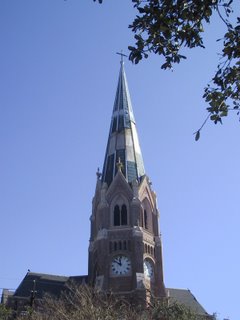
That's the steeple for St. Stephen's Catholic Church, across the street. I was noting in particular how several copper panels had been ripped away by the wind, exposing the wood underneath. The light areas are exposed wood, as the copper had darkened into a rich green patina in the more than one hundred years since the church was built. This shot, from another angle and greater distance, gives a better picture of the height of the steeple:
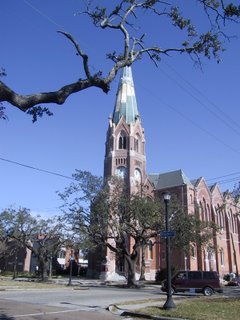
I wondered how they were going to repair this damage, whether they would replace all the copper, or just the missing panels. That would of course give the steeple a rather piebald look, with shiny new copper mixed in with patinaed old copper. For that matter, I wondered just how they were going to physically do the repairs. The spot is not exactly accessible.
Well, on Feb. 21, just before Mardi Gras, I got my answers. New copper mixed with old, and here's how they were doing the repairs:
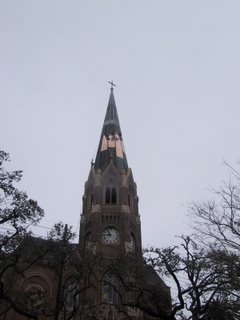
Don't see them? The construction workers in their mountaineering equipment? Well, take another look at the long shot above, to remind yourself of the scale, then check them out here:

Even if I were a husky 29-year-old construction worker, there is no amount of money in the world that would make me take that job.
Later, Mardi Gras pictures.

That's the steeple for St. Stephen's Catholic Church, across the street. I was noting in particular how several copper panels had been ripped away by the wind, exposing the wood underneath. The light areas are exposed wood, as the copper had darkened into a rich green patina in the more than one hundred years since the church was built. This shot, from another angle and greater distance, gives a better picture of the height of the steeple:

I wondered how they were going to repair this damage, whether they would replace all the copper, or just the missing panels. That would of course give the steeple a rather piebald look, with shiny new copper mixed in with patinaed old copper. For that matter, I wondered just how they were going to physically do the repairs. The spot is not exactly accessible.
Well, on Feb. 21, just before Mardi Gras, I got my answers. New copper mixed with old, and here's how they were doing the repairs:
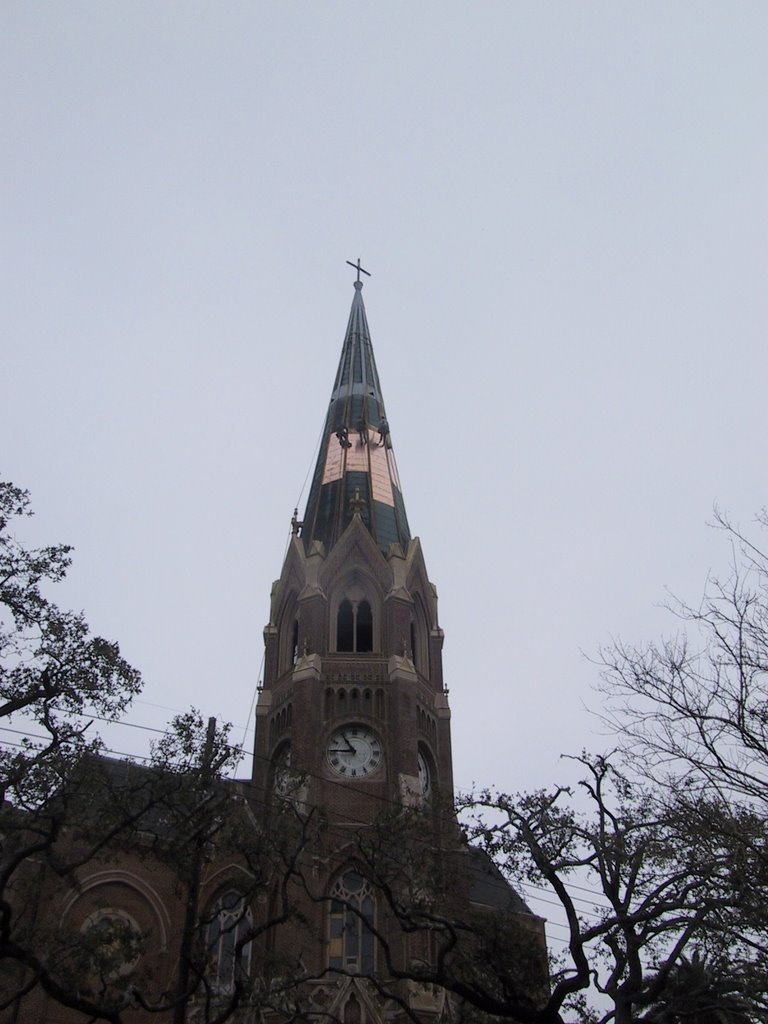
Don't see them? The construction workers in their mountaineering equipment? Well, take another look at the long shot above, to remind yourself of the scale, then check them out here:
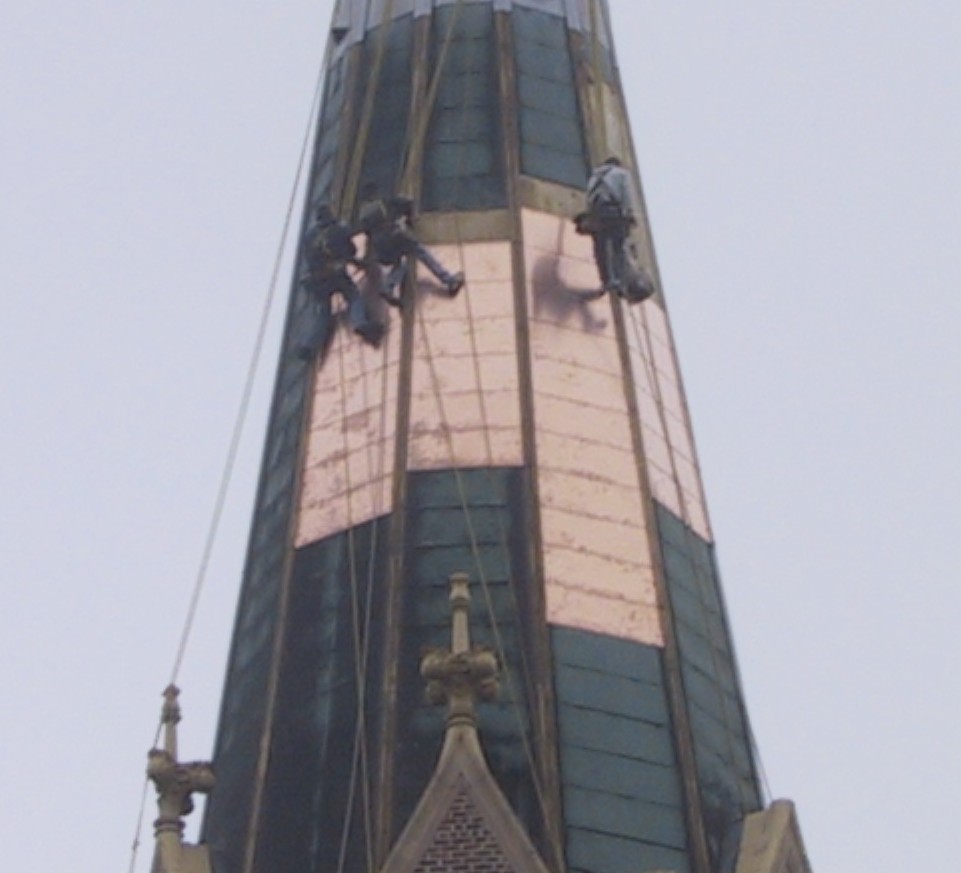
Even if I were a husky 29-year-old construction worker, there is no amount of money in the world that would make me take that job.
Later, Mardi Gras pictures.
Saturday, March 04, 2006
Scary, Scary Stuff
The Washington Post's Eugene Robinson just ran a column accompanied by this picture, of a bumpersticker seen on a car at Mardi Gras.

As Robinson puts it: Be afraid. Be very afraid.
Read the whole thing here.
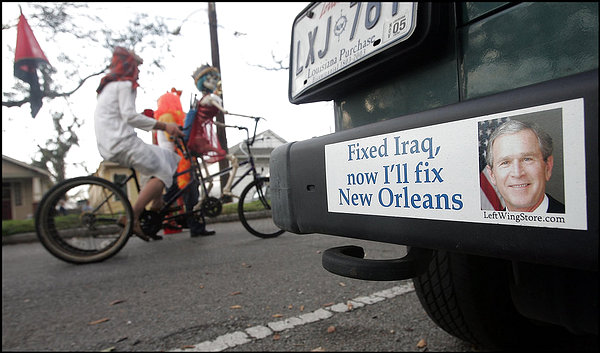
As Robinson puts it: Be afraid. Be very afraid.
Read the whole thing here.
Friday, March 03, 2006
Chris Does It Again
I'm not the first to notice this, but one of the most striking changes in New Orleans since It Happened has been the transformation of Chris Rose. Before, his Times-Picayune column was brilliantly written and funny, but definitely light hearted. Slice of life, what a wacky town we live in, that sort of stuff.
But since The Thing (a phrase of his invention) his work has taken on a definite edge. He's not such a happy go lucky guy any more, which is appropriate since none of us is. Since so few businesses in the city are open, for any serious shopping you have to go out to the suburbs, to Metairie, and there is just no way to get there without driving through the destruction. Which is to have your heart re-broken on an almost daily basis.
You have to toughen yourself, or you'd go insane, to the extent that you haven't already. Chris understands this perfectly, which is how he can write such killer columns as this.
But since The Thing (a phrase of his invention) his work has taken on a definite edge. He's not such a happy go lucky guy any more, which is appropriate since none of us is. Since so few businesses in the city are open, for any serious shopping you have to go out to the suburbs, to Metairie, and there is just no way to get there without driving through the destruction. Which is to have your heart re-broken on an almost daily basis.
You have to toughen yourself, or you'd go insane, to the extent that you haven't already. Chris understands this perfectly, which is how he can write such killer columns as this.
Tuesday, February 07, 2006
Idiot
I'm not in the habit of quoting myself, my own comments on other blogs, but this rant was too good to waste.
Richard over at Metroblogging New Orleans wrote an item pointing out that people who ask us, "Why haven't you got a recovery plan drawn up yet???" [and we do, though the Feds are trying to pretend we don't] ignore the fact that over four years after 9/11 New York still can't decide what to do about Ground Zero.
The first commenter, calling himself BlackBeard said, among other things:
This was too much. I replied in a fury with this:
I enjoyed that.
Richard over at Metroblogging New Orleans wrote an item pointing out that people who ask us, "Why haven't you got a recovery plan drawn up yet???" [and we do, though the Feds are trying to pretend we don't] ignore the fact that over four years after 9/11 New York still can't decide what to do about Ground Zero.
The first commenter, calling himself BlackBeard said, among other things:
Florida has been hit by more huricans they anyone in the united states and you dont here them crying. They gather together and make things work not sit back and wait for someone to do it for them. Its called TEAM WORK.[illiterate misspellings from original]
This was too much. I replied in a fury with this:
BB: I am in no mood to get lectured by anyone about teamwork. When the levees broke, 20,000 dead was the best estimate. In the end it was about 1,000 dead. Do you know why? Because of the largest urban search and rescue operation in history. And that's before the military got here.
New Orleans has a huge number of sport fishermen in it, most with their own boats. When the floods came, everyone who still had a working boat jumped into it and headed into the neighborhoods. They worked tirelessly for days, pulling people out of trees, off rooftops, sometimes cutting through roofs to save people trapped in attics. Then they ferried them to dry land, and turned around to go back for more. The paper profiled one, a black working class man who got his boat through hard work, not handouts, and who personally saved several hundred people, pausing only when it was too dark to navigate. There were hundreds more like him out there, saving who they could at risk of their own lives. They didn't plan it. They didn't wait for instructions. They just did what had to be done. This was the tribe taking care of its own. And you, you snide asshole, accuse us of sitting around on our butts and waiting for someone else to do things for us.
Fuck. You.
I enjoyed that.
Sunday, January 29, 2006
Neither snow nor rain, huh?
Here's another way that life has changed in New Orleans since The Thing happened. Nobody but nobody trusts the US Mail with anything of any value or importance. During the storm some rain gutters came loose and crashed down onto the compressor/heat pump of our heating/AC system, seriously damaging it. We got it repaired last week and the repairman, who we knew well because he had installed the compressor some years before, politely but firmly refused to bill us and let us send him a check. Now, please. Likewise the treasurer for my Quarter condo association, when we were settling up back condo dues from when we were in Jackson, asked me please to just come by and drop off the check, no mailing.
With good reason, too. The postal service has always been rather odd here. (Everywhere else in the country post offices close at 5:00; here they close at 4:30. Go figure.) But even now after five months, mail service is completely unreliable, and everybody knows it. T-P columnist James Gill wrote about his wife applying for unemployment compensation. The claim was denied in a mailed notice, which said she could appeal if she filed within seven days. The notice arrived well after the seven day deadline. (Fortunately she was already back at work.) I'm waiting for a DVD from Netflix that is over a week overdue. That's just an annoyance, but other things are more serious. My health insurance company requires me to use their by-mail pharmacy for regular prescriptions. I ordered a refill of some allergy medication with plenty of time to spare, and indeed it has been shipped. But it has not arrived, and I'm out.
Worse still, all across the region people are struggling with financial disaster just from what the storm and floods did. Before long I fear we're going to start hearing stories of already desperate people finding themselves being hounded by collections agencies for failing to pay bills they never received. As if we need more trouble.
With good reason, too. The postal service has always been rather odd here. (Everywhere else in the country post offices close at 5:00; here they close at 4:30. Go figure.) But even now after five months, mail service is completely unreliable, and everybody knows it. T-P columnist James Gill wrote about his wife applying for unemployment compensation. The claim was denied in a mailed notice, which said she could appeal if she filed within seven days. The notice arrived well after the seven day deadline. (Fortunately she was already back at work.) I'm waiting for a DVD from Netflix that is over a week overdue. That's just an annoyance, but other things are more serious. My health insurance company requires me to use their by-mail pharmacy for regular prescriptions. I ordered a refill of some allergy medication with plenty of time to spare, and indeed it has been shipped. But it has not arrived, and I'm out.
Worse still, all across the region people are struggling with financial disaster just from what the storm and floods did. Before long I fear we're going to start hearing stories of already desperate people finding themselves being hounded by collections agencies for failing to pay bills they never received. As if we need more trouble.
Thursday, January 19, 2006
Now We Know
I'm a big fan of writer, columnist, and überblogger James Lileks, and I read his "Daily Bleat" just about every weekday. As an old radio man, he recently has been doing weekly podcasts, which he calls "Bleatcasts," usually featuring an eclectic selection of music and radio from previous eras. ("Eclectic" means he just wings it, but at least he's honest about it.) A tail end baby boomer, he has great and genuine affection for the popular culture of all eras of the 20th century, except for the 70s, affection he shows through ruthless mockery.
But in his Bleatcast for January 6, 2006, he presents us with something of great relevance to us here in New Orleans just now. It's from the 1998 movie of The X-Files, a scene in which David Duchovny's Agent Mulder is being briefed by Dr. Kurzweil, played by Martin Landau, who does the Terrified Insider Who Knows Too Much bit better than just about anybody. After all those seasons of Mulder and Scully digging for the Truth Beneath It All, Kurzweil is trying to finally fill Mulder in on what the real secret is, the real danger lurking in the dark, who's really behind it all, what we really should be afraid of:
[Note: All of Lileks's Bleatcasts are worth hearing in their entirety, but if you're really impatient you can right-click here, download it, and with the mp3 player of your choice fast-forward to the 14 minute point.]
But in his Bleatcast for January 6, 2006, he presents us with something of great relevance to us here in New Orleans just now. It's from the 1998 movie of The X-Files, a scene in which David Duchovny's Agent Mulder is being briefed by Dr. Kurzweil, played by Martin Landau, who does the Terrified Insider Who Knows Too Much bit better than just about anybody. After all those seasons of Mulder and Scully digging for the Truth Beneath It All, Kurzweil is trying to finally fill Mulder in on what the real secret is, the real danger lurking in the dark, who's really behind it all, what we really should be afraid of:
Kurtzweil: [frightened, breathy voice] Are you familiar with the hanta virus, agent Mulder?
Mulder: Yeah, it was a deadly virus spread by field mice in the Southwestern United States several years ago.
Kurtzweil: According to the newspaper FEMA was called out to manage an outbreak of the hanta virus. Are you familiar with what the Federal Emergency Management Agency's real power is? . . . FEMA allows the White House to suspend constitutional government upon declaration of a national emergency. Think about that!! What is an agency with such broad sweeping power doing managing a small viral outbreak in suburban Texas.?
[spooky music starts]
Kurtzweil: I think you know. . . . The timetable has been set. It'll happen on a holiday when people are away from their homes. The President will declare a state of emergency at which time all government, all federal agencies, will come under the power . . [whispers] . . of the Federal Emergency Management Agency. . . FEMA!! . . . . . The secret government . . .
Mulder: [pause]. . .They call me paranoid . . .
[Note: All of Lileks's Bleatcasts are worth hearing in their entirety, but if you're really impatient you can right-click here, download it, and with the mp3 player of your choice fast-forward to the 14 minute point.]
Monday, January 16, 2006
That City Council
Now that the mayor's Bring New Orleans Back commission has released its urban planning report, and now that the City Council has responded by screaming "Over our dead bodies!!", everyone's wondering, now just what the hell are they up to?
Protecting their own interests of course. When we first started talking about rebuilding, their position was that every neighborhood, no matter how badly flooded, should be immediately opened to rebuilding. This is not a plan, it is an absense of a plan, and would just be setting us up for a repeat of the disaster.
The BNOB plan at least has some realism to it. Some areas are going to be just too dangerous to repopulate, unless the Feds come up with Cat 5 levee protection. Much of the population has been scattered across the country, and the estimate is that by two years from now only half will have come back. Neighborhoods have to have a certain population density to be viable, and if dangerous neighborhoods end up lightly populated, it makes sense to buy out the property owners and help several neighborhoods consolidate into a new, properly dense neighborhood in a safer location.
That's the gist of it anyway. We're all still studying the details. We have to make sure it's flexible, for one thing. They estimate 200,000 will come back within a few years, but if 300,000 want to we can hardly tell them no.
But I was talking about the City Council. Why they were previously saying "rebuild everywhere!", and why they are now so furious about the idea of buyouts or, in the worst cases, confiscation through eminent domain. I can see several reasons for their behavior, some admirable, others less so.
One is that hard decisions are easier to accept if you make them yourself. When I was an AIDS Hotline counselor back in the 80s, the first thing they taught us in training was never to give advice. This struck me as odd, but they explained. People called because they needed help in making decisions with literally life or death consequences. But their best chance of sticking with a decision was if they made it themselves, not just followed advice. The most you could do was talk them through all the consequences of various choices, until they saw which ones made sense.
The Lower 9th Ward is never going to be restored to what it was. If they haven't already done so, many owners will come back, see what's left, and realize it is economically impossible to try and rebuild. For them, a buyout based on pre-Katrina property values is probably the best they will get. If the council is trying to get people to come back, make an assessment, and make those hard choices themselves, that's fine.
But.... Americans are not very good at meekly taking orders from authority. If it's hard enough to decide you can't rebuild, it's impossible to accept being TOLD you can't rebuild, and the very possibility of that produces the fury we've been seeing at public hearings. And as we humans have incredible powers of rationalization, anyone who is prevented from trying to recreate his destroyed home will believe to the day he dies that he could have put it all back together if the guv'mint had only given him a chance.
Property owners -- and voters -- who are in such an enraged state of mind are disinclined to re-elect. The council members know this, and know they will be the first to feel the voters' wrath if it comes to that. I fear that's why they are encouraging this fantasy that everything can be put back just the way it was if the mayor and the governor and so on would just give the go ahead. I think that they know perfectly well what is going to have to happen, that the physical and social architecture of the city is going to change. This is a more complex matter than just shrinking the boundaries, or "footprint", of the city. Much will change, and the City Council members are moving to make sure that the enraged displaced will see someone else as the bad guy, not them. That's fine up to a point, but when they go past that point they are trying to save their electoral skins at the risk of doing irreperable damage to New Orleans's chances of recovery. That's not fine at all.
Protecting their own interests of course. When we first started talking about rebuilding, their position was that every neighborhood, no matter how badly flooded, should be immediately opened to rebuilding. This is not a plan, it is an absense of a plan, and would just be setting us up for a repeat of the disaster.
The BNOB plan at least has some realism to it. Some areas are going to be just too dangerous to repopulate, unless the Feds come up with Cat 5 levee protection. Much of the population has been scattered across the country, and the estimate is that by two years from now only half will have come back. Neighborhoods have to have a certain population density to be viable, and if dangerous neighborhoods end up lightly populated, it makes sense to buy out the property owners and help several neighborhoods consolidate into a new, properly dense neighborhood in a safer location.
That's the gist of it anyway. We're all still studying the details. We have to make sure it's flexible, for one thing. They estimate 200,000 will come back within a few years, but if 300,000 want to we can hardly tell them no.
But I was talking about the City Council. Why they were previously saying "rebuild everywhere!", and why they are now so furious about the idea of buyouts or, in the worst cases, confiscation through eminent domain. I can see several reasons for their behavior, some admirable, others less so.
One is that hard decisions are easier to accept if you make them yourself. When I was an AIDS Hotline counselor back in the 80s, the first thing they taught us in training was never to give advice. This struck me as odd, but they explained. People called because they needed help in making decisions with literally life or death consequences. But their best chance of sticking with a decision was if they made it themselves, not just followed advice. The most you could do was talk them through all the consequences of various choices, until they saw which ones made sense.
The Lower 9th Ward is never going to be restored to what it was. If they haven't already done so, many owners will come back, see what's left, and realize it is economically impossible to try and rebuild. For them, a buyout based on pre-Katrina property values is probably the best they will get. If the council is trying to get people to come back, make an assessment, and make those hard choices themselves, that's fine.
But.... Americans are not very good at meekly taking orders from authority. If it's hard enough to decide you can't rebuild, it's impossible to accept being TOLD you can't rebuild, and the very possibility of that produces the fury we've been seeing at public hearings. And as we humans have incredible powers of rationalization, anyone who is prevented from trying to recreate his destroyed home will believe to the day he dies that he could have put it all back together if the guv'mint had only given him a chance.
Property owners -- and voters -- who are in such an enraged state of mind are disinclined to re-elect. The council members know this, and know they will be the first to feel the voters' wrath if it comes to that. I fear that's why they are encouraging this fantasy that everything can be put back just the way it was if the mayor and the governor and so on would just give the go ahead. I think that they know perfectly well what is going to have to happen, that the physical and social architecture of the city is going to change. This is a more complex matter than just shrinking the boundaries, or "footprint", of the city. Much will change, and the City Council members are moving to make sure that the enraged displaced will see someone else as the bad guy, not them. That's fine up to a point, but when they go past that point they are trying to save their electoral skins at the risk of doing irreperable damage to New Orleans's chances of recovery. That's not fine at all.
Tuesday, January 10, 2006
Next Stop Alpha Centauri
The highly regarded science weekly New Scientist has in its current issue, available online, an extraordinary article outlining the possibility of testing a form of warp drive within five years.
Allow me to repeat that: WARP DRIVE IN FIVE YEARS!!!!
It involves an extremely obscure branch of physics called Heim theory, worked out by an extremely obscure physicist, Burkhart Heim, in the 1950s. Heim was trying to reconcile the inconsistencies between quantum theory and Einstein's general relativity, a process postulating at least a few more dimensions than the ones we're familiar with, and along the way he came up with a way to, at least theoretically, propel a vessel many times faster than the ordinary speed of light.
Obviously this has never been tested. Very few people know about Heim theory, and hardly anyone understands it, as the mathematics are incredibly difficult. The person most able to promote Heim theory, Heim himself, shunned publicity due to the disfiguring injuries he suffered in an explosives accident towards the end of WWII. The only aspect of Heim theory that has been tested, in computer simulation at a lab in Germany, involves predicting the mass of elementary particles. In this, Heim theory succeeds wildly beyond the capabilities of conventional physics.
There is at least one advanced research facility that has said, if the math could be clarified for them and if they agreed it made sense, they might be able to physically test it within five years. Even if the test succeeds, of course, that's a long, long way from building the Enterprise-A. But to know it was even possible would completely revolutionize our view of the universe and our place in it. Think of it: Mars in three hours, a star 11 light years away in 80 days.
Boy I wish James Doohan had lived to hear of this. The thought that Scotty's beloved engine room might someday exist would have made his heart soar.
Allow me to repeat that: WARP DRIVE IN FIVE YEARS!!!!
It involves an extremely obscure branch of physics called Heim theory, worked out by an extremely obscure physicist, Burkhart Heim, in the 1950s. Heim was trying to reconcile the inconsistencies between quantum theory and Einstein's general relativity, a process postulating at least a few more dimensions than the ones we're familiar with, and along the way he came up with a way to, at least theoretically, propel a vessel many times faster than the ordinary speed of light.
Obviously this has never been tested. Very few people know about Heim theory, and hardly anyone understands it, as the mathematics are incredibly difficult. The person most able to promote Heim theory, Heim himself, shunned publicity due to the disfiguring injuries he suffered in an explosives accident towards the end of WWII. The only aspect of Heim theory that has been tested, in computer simulation at a lab in Germany, involves predicting the mass of elementary particles. In this, Heim theory succeeds wildly beyond the capabilities of conventional physics.
There is at least one advanced research facility that has said, if the math could be clarified for them and if they agreed it made sense, they might be able to physically test it within five years. Even if the test succeeds, of course, that's a long, long way from building the Enterprise-A. But to know it was even possible would completely revolutionize our view of the universe and our place in it. Think of it: Mars in three hours, a star 11 light years away in 80 days.
Boy I wish James Doohan had lived to hear of this. The thought that Scotty's beloved engine room might someday exist would have made his heart soar.
Monday, January 09, 2006
Cry Me a New Year
If you're a local reader you don't need to be told who Chris Rose is. If you're one of my legion of readers from elsewhere (Hi Mom!) he is a first rate columnist for the Times-Picayune, covering a general New Orleans cultural beat. We always knew he was good, but what he has written since Katrina has been phenomenal. He fled the storm with his wife and two small children, but within a week, once he had made them to safety, he was back, trying to convey the raw experience of what he saw and felt.
He is an incredibly honest reporter, whether or not it makes him look good. To round out 2005 he wrote an article, "Cry Me a New Year," and this passage breaks my heart every time I read it:
You can read that column here.
He is an incredibly honest reporter, whether or not it makes him look good. To round out 2005 he wrote an article, "Cry Me a New Year," and this passage breaks my heart every time I read it:
The first time I went to the Winn-Dixie after it reopened, I had all my purchases on the conveyer belt, plus a bottle of mouthwash. During the Days of Horror following the decimation of this city, I had gone into the foul and darkened store and lifted a bottle.
I was operating under the "take only what you need" clause that the strays who remained behind in this godforsaken place invoked in the early days.
My thinking was that it was in everyone's best interest if I had a bottle of mouthwash.
When the cashier rang up my groceries all those weeks later, I tried, as subtly as possible, to hand her the bottle and ask her if she could see that it was put back on the shelf. She was confused by my action and offered to void the purchase if I didn't want the bottle.
I told her it's not that I didn't want it, but that I wished to pay for it and could she please see that it was put back on the shelf. More confusion ensued and the line behind me got longer and it felt very hot and crowded all of a sudden and I tried to tell her: "Look, when the store was closed . . . you know . . . after the thing . . . I took . . ."
The words wouldn't come. Only the tears.
The people in line behind me stood stoic and patient, public meltdowns being as common as discarded kitchen appliances in this town.
What's that over there? Oh, it's just some dude crying his butt off. Nothing new here. Show's over people, move along.
The cashier, an older woman, finally grasped my pathetic gesture, my lowly attempt to make amends, my fulfillment to a promise I made to myself to repay anyone I had stolen from.
"I get it, baby," she said, and she gently took the bottle from my hands and I gathered my groceries and walked sobbing from the store.
She was kind to me. I probably will never see her again, but I will never forget her. That bottle. That store. All the fury that prevailed. The fear.
You can read that column here.
Sunday, January 08, 2006
Fun with FEMA
Tim has some fascinating insights into what it's like dealing with FEMA in New Orleans these days, though of course, he's not complaining.
Saturday, January 07, 2006
Back to the Misery Tour
In December Time magazine ran their annual feature of the best photos of the previous year. Not surprisingly, Katrina photos led the pack. One of the most dramatic was this photo by the acclaimed photojournalist Thomas Dworzak:
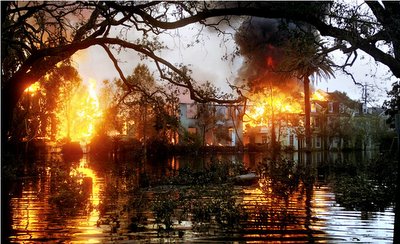
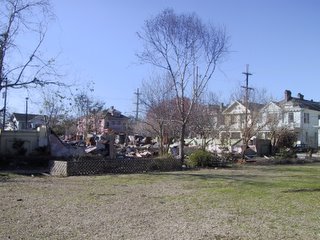
It captures vividly the unreality and sheer craziness of the situation in New Orleans at that time, just after the storm had passed and the levees had broken; buildings surrounded by water yet engulfed in flame. [Note: click on any of these pictures for a closer look.] Time made only one mistake. In the photo caption they located this scene in the Garden District, an area closer to Downtown where many of the most beautiful old 19th century mansions can be found. It isn't. It's Uptown in the 2100 block of Napoleon Avenue, about ten blocks from my house. This is what that center building looks like today:
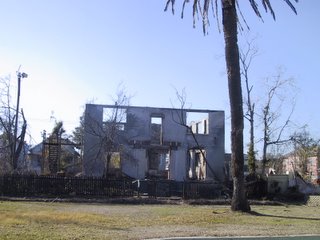
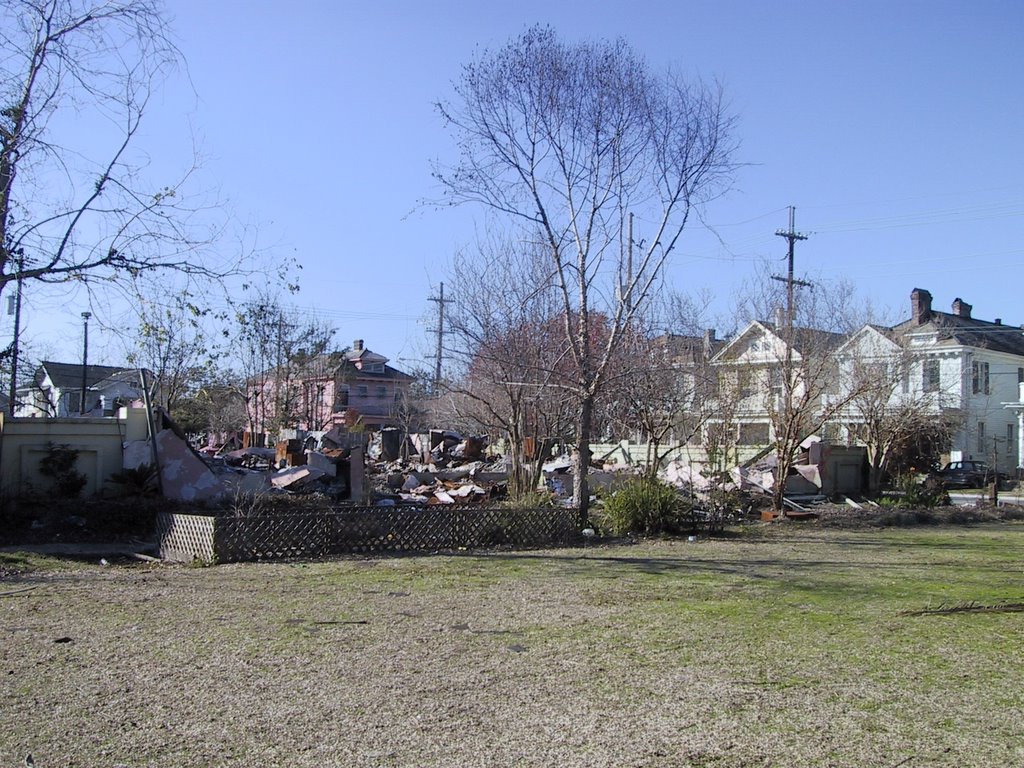
The grass in the foreground is where all that water was. It's a small park with a playground. I sometimes walk my dog there. That palm tree can be seen in Dworzak's photo, silhouetted against the right edge of the right-hand fireball. The houses producing that fireball were fairly expensive condos. This is what's left:
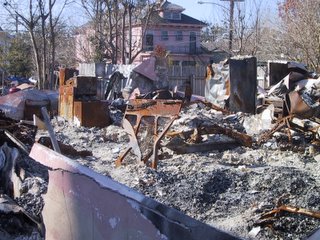
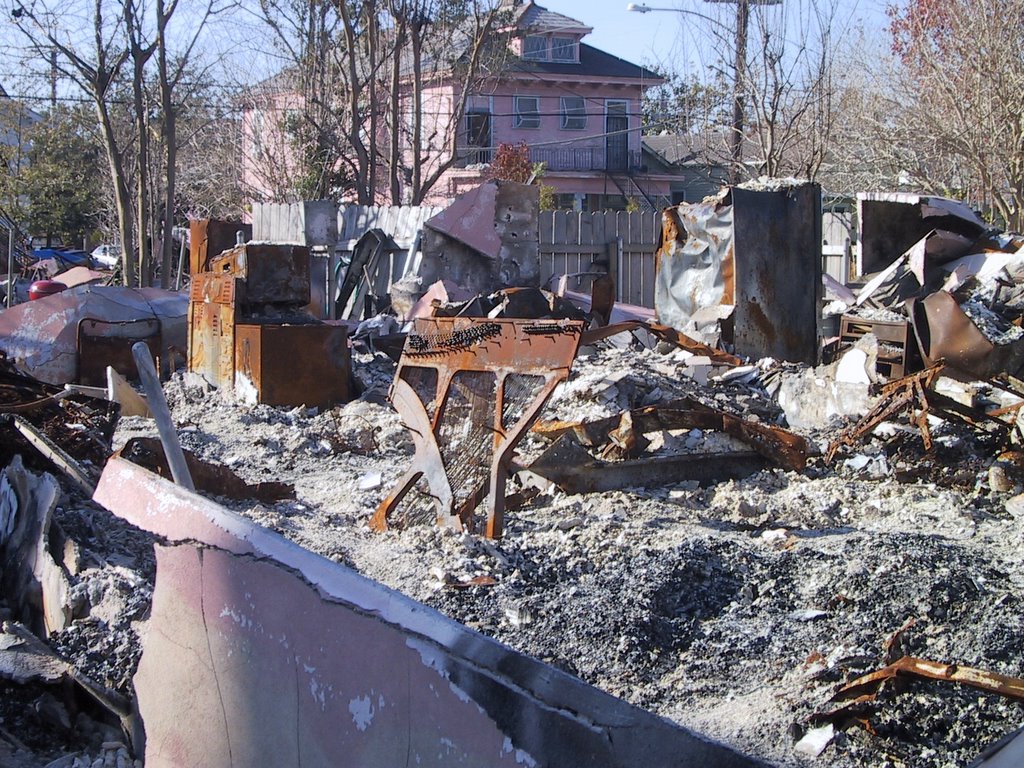
In the center of this photo is a sort of rust-covered metal frame. That is the skeletal remains of an upright piano.
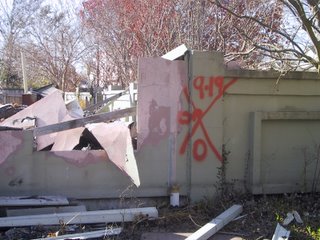
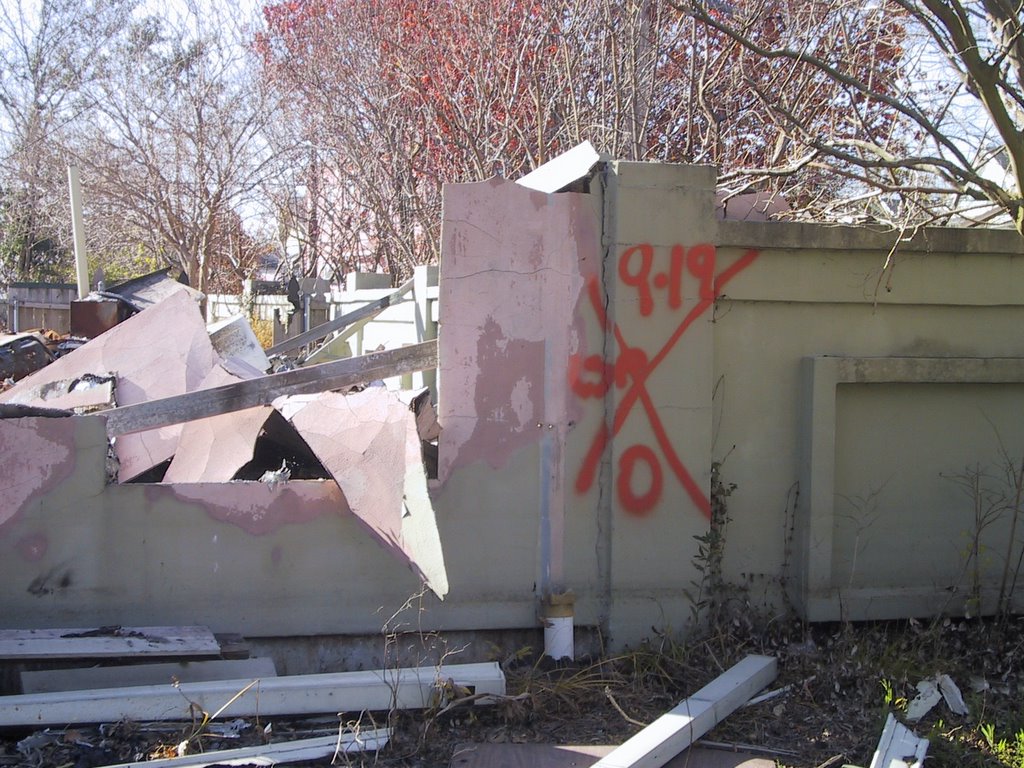
If there's any good news, it's this. I've learned to read these sort of markings well enough to know that the "0" on the bottom means no bodies were found here. The people who lived here may have lost all their possessions, but not their lives.
What's depressing is the realization that, since I drive past here fairly often, I'm going to have to look at these ruined shells for months, if not years. There's too much work to be done on houses that can still be salvaged to spare any effort to clean up a total loss like this.
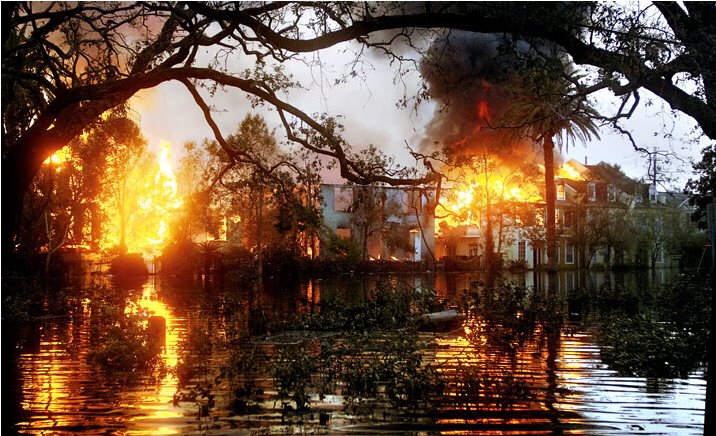
It captures vividly the unreality and sheer craziness of the situation in New Orleans at that time, just after the storm had passed and the levees had broken; buildings surrounded by water yet engulfed in flame. [Note: click on any of these pictures for a closer look.] Time made only one mistake. In the photo caption they located this scene in the Garden District, an area closer to Downtown where many of the most beautiful old 19th century mansions can be found. It isn't. It's Uptown in the 2100 block of Napoleon Avenue, about ten blocks from my house. This is what that center building looks like today:

The grass in the foreground is where all that water was. It's a small park with a playground. I sometimes walk my dog there. That palm tree can be seen in Dworzak's photo, silhouetted against the right edge of the right-hand fireball. The houses producing that fireball were fairly expensive condos. This is what's left:
In the center of this photo is a sort of rust-covered metal frame. That is the skeletal remains of an upright piano.
If there's any good news, it's this. I've learned to read these sort of markings well enough to know that the "0" on the bottom means no bodies were found here. The people who lived here may have lost all their possessions, but not their lives.
What's depressing is the realization that, since I drive past here fairly often, I'm going to have to look at these ruined shells for months, if not years. There's too much work to be done on houses that can still be salvaged to spare any effort to clean up a total loss like this.
Wednesday, January 04, 2006
Story Time
I seem to be drifting towards stating my views on the contentious subject of multiculturalism. If so, then before I do I'm going to take the chance to tell an absolutely wonderful story, a cautionary tale about not underestimating people. It comes from a book by Robert Georges called People Studying People that I read as a textbook when I was in grad school.
During the 1890s university academics, particularly in the US, started rethinking the question of how to study and research non-Western societies, especially the less developed ones. The previous attitude had been to dismiss as "primitive" any societies that did not have an extensive written history, and even some that did, such as Japan, China and India, tended to be patronized just for not being European.
Scholars came to realize that there was much of interest and value in such cultures, but realized it was going to be difficult to get at by the means they were used to. Societies without libraries and archives are impenetrable to a scholar if libraries and archives are all he knows. So over this period they developed the practice of what we now call fieldwork, studying a society by immersing yourself in it. Living among the people you're studying, learning their language, their songs and legends, helping to hunt or farm. Learning their way of life by sharing it for a while. This seems obvious to us now, but it was revolutionary then.
Among the first cultures to be studied this way were American Indian tribes, and for good reason. They were easy to get to by train and horseback, there was always somebody around who spoke English, and since scholars were still trying to feel their way, develop these techniques, it was a lot safer to study the Navaho than to plunge into the jungles of New Guinea.
Around 1905 a young man from a university back east arrived on a reservation to do his fieldwork. As I cannot remember his name (Amazon will sell you Georges's book if you're dying to know), I will just call him the Scholar. He had made arrangements to live with a local family, and had been there a week or two, just finding his way around, when he was approached by a young man with the wondrous and unforgettable name of Wolf Lies Down. He wanted to know what the Scholar was doing there. He wasn't hostile or anything, but wondered if the Scholar was maybe a trader looking to buy some of the tribe's horses, and maybe they could do some business.
The Scholar wanted to answer honestly, but wasn't quite sure how. How to explain such abstract notions as scholarship and research to this local lad? But he had heard that when explaining difficult concepts to children, one started with the most concrete examples and worked your way up to the abstract. What would work with children would surely work with this simple aborigine.
So he said, "Well, I want to talk to you, to your friends and family, and find out how you live. I want to see the houses you live in and the clothes you wear. I want to see the food your grow, and watch how your women cook it. I want to see the games your children play, and hear the songs they sing. I want to listen to the stories your old men tell, stories of how the world came to be and how it was when they were young. I want to...."
And he was working up some enthusiasm here, really getting on a roll when Wolf Lies Down, who had never in his life been off the reservation, interrupted him and said, "Ah! I see. You're an ethnologist," smiled politely, nodded, and walked away.
It is to my everlasting sorrow that the Scholar did not record his own reaction to this incident.
During the 1890s university academics, particularly in the US, started rethinking the question of how to study and research non-Western societies, especially the less developed ones. The previous attitude had been to dismiss as "primitive" any societies that did not have an extensive written history, and even some that did, such as Japan, China and India, tended to be patronized just for not being European.
Scholars came to realize that there was much of interest and value in such cultures, but realized it was going to be difficult to get at by the means they were used to. Societies without libraries and archives are impenetrable to a scholar if libraries and archives are all he knows. So over this period they developed the practice of what we now call fieldwork, studying a society by immersing yourself in it. Living among the people you're studying, learning their language, their songs and legends, helping to hunt or farm. Learning their way of life by sharing it for a while. This seems obvious to us now, but it was revolutionary then.
Among the first cultures to be studied this way were American Indian tribes, and for good reason. They were easy to get to by train and horseback, there was always somebody around who spoke English, and since scholars were still trying to feel their way, develop these techniques, it was a lot safer to study the Navaho than to plunge into the jungles of New Guinea.
Around 1905 a young man from a university back east arrived on a reservation to do his fieldwork. As I cannot remember his name (Amazon will sell you Georges's book if you're dying to know), I will just call him the Scholar. He had made arrangements to live with a local family, and had been there a week or two, just finding his way around, when he was approached by a young man with the wondrous and unforgettable name of Wolf Lies Down. He wanted to know what the Scholar was doing there. He wasn't hostile or anything, but wondered if the Scholar was maybe a trader looking to buy some of the tribe's horses, and maybe they could do some business.
The Scholar wanted to answer honestly, but wasn't quite sure how. How to explain such abstract notions as scholarship and research to this local lad? But he had heard that when explaining difficult concepts to children, one started with the most concrete examples and worked your way up to the abstract. What would work with children would surely work with this simple aborigine.
So he said, "Well, I want to talk to you, to your friends and family, and find out how you live. I want to see the houses you live in and the clothes you wear. I want to see the food your grow, and watch how your women cook it. I want to see the games your children play, and hear the songs they sing. I want to listen to the stories your old men tell, stories of how the world came to be and how it was when they were young. I want to...."
And he was working up some enthusiasm here, really getting on a roll when Wolf Lies Down, who had never in his life been off the reservation, interrupted him and said, "Ah! I see. You're an ethnologist," smiled politely, nodded, and walked away.
It is to my everlasting sorrow that the Scholar did not record his own reaction to this incident.
Monday, January 02, 2006
Not Schadenfreude
I really take no pleasure at all at the plight of the folks in Northern California just now. Hell, that's where I come from, and nobody could be more sensitive to the tragedy of flood damage than the people who live where I do now. But when I saw this picture on the front page of the New York Times . . .

. . . can I be forgiven a slight feeling of something like relief at seeing a water related disaster photo that was not taken in Louisiana?
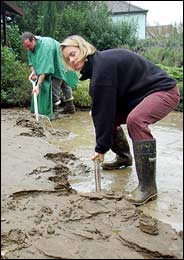
. . . can I be forgiven a slight feeling of something like relief at seeing a water related disaster photo that was not taken in Louisiana?
Sunday, January 01, 2006
Go Cosmopolitans!
Occasionally one is lucky enough to run across a book or article that neatly crystallizes your feelings and thoughts on a subject, brings into focus what you've long since believed and helps you conceptualize the reasons for what you've thought all along. This article from today's New York Times magazine does it brilliantly for me on the subjects of multiculturalism, cultural imperialism, preserving traditional ways of life, and so on. The verdict: more cultural contamination, please.
The author, Kwame Anthony Appiah, should know. He's a native of Ghana and related by marriage to the most recent three Ashante kings. But his mother is British and he teaches philosphy at Princeton University. He makes a strong argument for the position that the cultural preservationists, such as those in Unesco who recently passed a resolution for the "protection and promotion" of cultural diversity, are not only fighting a losing battle, they have taken a side which should lose.
Preserving cultural artifacts, like artwork or music or architecture or history, is fine. But those who would preserve entire traditional cultures because they're somehow more "authentic" than the modern world make a terrible mistake. They forget that a charmingly authentic African village is usually that way because its people are too poor to be otherwise. They may be desperate to change, to modernize, knowing full well what modernization will bring, but don't have the resources. You cannot preserve the culture of a poor rural area -- as opposed to its cultural artifacts -- without locking its people into poverty, with all the disease, misery, short life expectancy, and infant mortality that poverty produces. This is hardly an act of kindness, and certainly not what they would choose for themselves.
Not only is this a cruel thing to do, not only is it impossible -- there is no village in Ghana so poor it doesn't have radios, and most Ghanaians have cell phones -- but it's ridiculous and foolish, as there simply are no pure and authentic cultures anywhere. Haven't been for thousands of years. We've been mixing and matching ever since we became human.
Here's a lovely example I gleaned from the article. If you say "traditional African" to most Americans, they think first off in terms of clothing. Every year at Kwanzaa you'll see African-Americans wearing something like this:
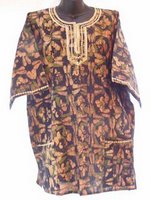
An ancient African clothmaking tradition, right? Hardly. That kind of cloth is called a Java print, as its origins are in the Javanese batik print cloth imported into Africa in the 19th century by Dutch traders. Sometimes the cloth didn't even come from Java, but was made and printed by the Dutch themselves. Think about that. 19th century cloth mill owners in Holland making printed cloth they thought Africans would like and would buy, thereby both reflecting and influencing the "traditional" look of African clothing.
You want something more traditional, you might go for some authentic kente cloth, like this:

This is handwoven cloth, a traditional handcraft of the highest quality, and the finest and most expensive kente cloth is made in the village of Bonwire out of silk. Wait a minute, silk? Are silkworms native to Africa? Indeed they are not. They're native to Asia, and the silk for kente cloth has always been imported, again usually by Europeans.
So you can't preserve pure, authentic, traditional cultures, because there aren't any. Anywhere.
There's more in the article. It's worth a read.
The author, Kwame Anthony Appiah, should know. He's a native of Ghana and related by marriage to the most recent three Ashante kings. But his mother is British and he teaches philosphy at Princeton University. He makes a strong argument for the position that the cultural preservationists, such as those in Unesco who recently passed a resolution for the "protection and promotion" of cultural diversity, are not only fighting a losing battle, they have taken a side which should lose.
Preserving cultural artifacts, like artwork or music or architecture or history, is fine. But those who would preserve entire traditional cultures because they're somehow more "authentic" than the modern world make a terrible mistake. They forget that a charmingly authentic African village is usually that way because its people are too poor to be otherwise. They may be desperate to change, to modernize, knowing full well what modernization will bring, but don't have the resources. You cannot preserve the culture of a poor rural area -- as opposed to its cultural artifacts -- without locking its people into poverty, with all the disease, misery, short life expectancy, and infant mortality that poverty produces. This is hardly an act of kindness, and certainly not what they would choose for themselves.
Not only is this a cruel thing to do, not only is it impossible -- there is no village in Ghana so poor it doesn't have radios, and most Ghanaians have cell phones -- but it's ridiculous and foolish, as there simply are no pure and authentic cultures anywhere. Haven't been for thousands of years. We've been mixing and matching ever since we became human.
Here's a lovely example I gleaned from the article. If you say "traditional African" to most Americans, they think first off in terms of clothing. Every year at Kwanzaa you'll see African-Americans wearing something like this:

An ancient African clothmaking tradition, right? Hardly. That kind of cloth is called a Java print, as its origins are in the Javanese batik print cloth imported into Africa in the 19th century by Dutch traders. Sometimes the cloth didn't even come from Java, but was made and printed by the Dutch themselves. Think about that. 19th century cloth mill owners in Holland making printed cloth they thought Africans would like and would buy, thereby both reflecting and influencing the "traditional" look of African clothing.
You want something more traditional, you might go for some authentic kente cloth, like this:

This is handwoven cloth, a traditional handcraft of the highest quality, and the finest and most expensive kente cloth is made in the village of Bonwire out of silk. Wait a minute, silk? Are silkworms native to Africa? Indeed they are not. They're native to Asia, and the silk for kente cloth has always been imported, again usually by Europeans.
So you can't preserve pure, authentic, traditional cultures, because there aren't any. Anywhere.
There's more in the article. It's worth a read.
Wednesday, December 28, 2005
A Brief Tour
As I've started getting reoriented to living in a drastically altered New Orleans, I've been taking pictures as I drive around. I'm going to start sharing some of them right here. You can click on any picture to get a closer look. Let's start in my immediate neighborhood.
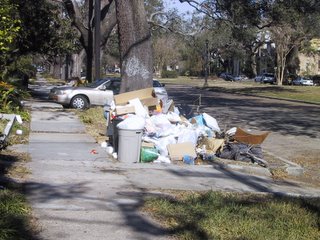
This is a pile of trash in front of a house on my block, waiting for the city to get around to picking it up. This is a fairly small pile, as the house was not significantly damaged. There are piles like this all over the place.

The park in the next block where I walk my dog. When we left for Jackson, these trees were all standing straight up, and looked alive. Neither now, it seems. Note that branches are not broken by any impact. Nothing hit them to knock them over. Only wind.
Remember, this is the part of town that got off easy when Katrina came through.
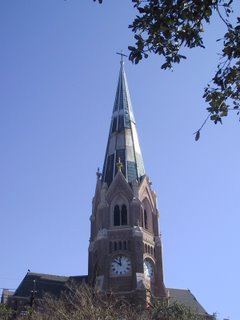
The steeple of St. Stephen's Catholic Church, directly across the street from my house. It used to be completely sheathed in copper. Not any more.
I wonder who got the copper?
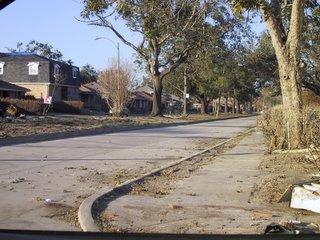
I've been driving around the city as well. This is a street in an area known as Lakeview, which lies between the Orleans Ave. canal and the infamous 17th Street Canal, the one that broke open.
Not one house on this street is habitable. There are hundreds of miles of streets like this in New Orleans.
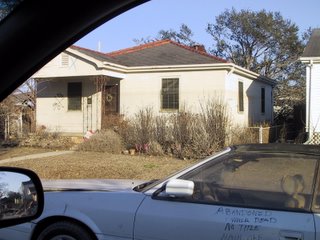
On the walls of the house in the background you can see a horizontal line, with the wall appearing slightly lighter in color above it and slightly darker below it. The line would be right about at eye level of someone standing in the doorway. This indicates the flood level, the maximum height to which the water rose. To visualize what really happened it helps to picture the space between the house and the house seen at the right edge filled with water to that point. Now extend it. Imagine the water extending towards you at that height, then away from you, then right and left, for miles. That's a lot of water.
You can also see on the front wall a spray painted inspection marker. It's a large X with the top and bottom quadrants being the most important. The top indicates the date of inspection, in this case 9/29. The bottom indicates the number of dead bodies found inside, in this case zero.
The car, on the other hand, has written on its door "Abandoned / owner dead / no title / haul off." No one has, yet. As the flood level marks on the house indicate it was completely submerged when the water came, no one has bothered to try stealing it either. What would be the point?
Cheerful stuff, isn't it? More to come.

This is a pile of trash in front of a house on my block, waiting for the city to get around to picking it up. This is a fairly small pile, as the house was not significantly damaged. There are piles like this all over the place.

The park in the next block where I walk my dog. When we left for Jackson, these trees were all standing straight up, and looked alive. Neither now, it seems. Note that branches are not broken by any impact. Nothing hit them to knock them over. Only wind.
Remember, this is the part of town that got off easy when Katrina came through.

The steeple of St. Stephen's Catholic Church, directly across the street from my house. It used to be completely sheathed in copper. Not any more.
I wonder who got the copper?

I've been driving around the city as well. This is a street in an area known as Lakeview, which lies between the Orleans Ave. canal and the infamous 17th Street Canal, the one that broke open.
Not one house on this street is habitable. There are hundreds of miles of streets like this in New Orleans.
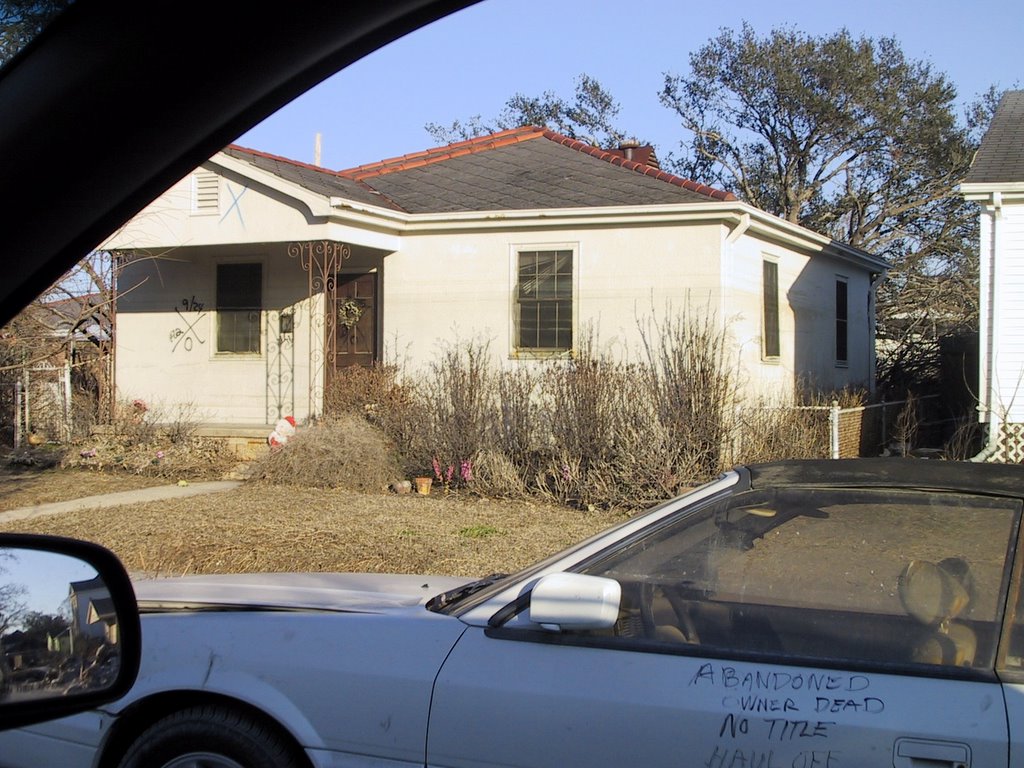
On the walls of the house in the background you can see a horizontal line, with the wall appearing slightly lighter in color above it and slightly darker below it. The line would be right about at eye level of someone standing in the doorway. This indicates the flood level, the maximum height to which the water rose. To visualize what really happened it helps to picture the space between the house and the house seen at the right edge filled with water to that point. Now extend it. Imagine the water extending towards you at that height, then away from you, then right and left, for miles. That's a lot of water.
You can also see on the front wall a spray painted inspection marker. It's a large X with the top and bottom quadrants being the most important. The top indicates the date of inspection, in this case 9/29. The bottom indicates the number of dead bodies found inside, in this case zero.
The car, on the other hand, has written on its door "Abandoned / owner dead / no title / haul off." No one has, yet. As the flood level marks on the house indicate it was completely submerged when the water came, no one has bothered to try stealing it either. What would be the point?
Cheerful stuff, isn't it? More to come.
Tuesday, December 27, 2005
LOTR: The Inside Story
I absolutely adore Peter Jackson's Lord of the Rings trilogy. I fell in love with the books when I was a teenager, and can't guess how many times I've read them. Because previous attempts to put them on the screen had failed so miserably (Ralph Bakshi, urgh) I was very wary when I heard someone was shooting a live action version, in New Zealand of all places. So I was thrilled when I saw the first still publicity shots that were released, of Frodo and Bilbo in Rivendell; they clearly had come up with a look for the films that was magnificently done and damn near perfect. The first internet teasers that were released got me so excited I couldn't stand it. And when I finally saw Fellowship, I practically cried tears of joy that someone had cared enough to do it right.
However.
Nothing, or at least very little, is so sacred that it can't stand a little mockery. In fact, the stronger you are, the better you can take it. So I was fascinated and delighted to find that each of the characters, Aragorn, Legolas, and so on, had kept Very Secret Diaries as events progressed. It is interesting, it truly is, to find out some of the real motivations and off-screen detail, the stuff that Jackson just didn't have time to share with us. Such as that the balrog's rather over-the-top behavior in Moria was the result of festering anger from a bad date with Gandalf back in the Second Age (the balrog got stuck with the check). Or that, while it really shouldn't have worked since everyone knows it already, Boromir was still able to get some with that old "Hey, wanna blow the Horn of Gondor?" line.
Read and enjoy. You pervy hobbit-fancier.
However.
Nothing, or at least very little, is so sacred that it can't stand a little mockery. In fact, the stronger you are, the better you can take it. So I was fascinated and delighted to find that each of the characters, Aragorn, Legolas, and so on, had kept Very Secret Diaries as events progressed. It is interesting, it truly is, to find out some of the real motivations and off-screen detail, the stuff that Jackson just didn't have time to share with us. Such as that the balrog's rather over-the-top behavior in Moria was the result of festering anger from a bad date with Gandalf back in the Second Age (the balrog got stuck with the check). Or that, while it really shouldn't have worked since everyone knows it already, Boromir was still able to get some with that old "Hey, wanna blow the Horn of Gondor?" line.
Read and enjoy. You pervy hobbit-fancier.
Monday, December 26, 2005
Christmas Lights: Pedal to the Metal
We're in that peculiar hang time, where Christmas Day is past but Christmas isn't really over, not until New Year's Eve and New Year's Day wipe the slate clean. We can still talk about holiday things without it being totally tacky, as it would be seven days from now.
So I can still talk about this guy without violating natural law. Using 25,000 lights and a computer driven music synchronization system, Mr. Carson Williams of Deerfield, Ohio, created the most jaw-dropping Christmas light animated display ever to adorn an ordinary suburban house, synchronized to a track by the Trans-Siberian Orchestra. His neighbors supported him whole heartedly, not least because there was no noise; the soundtrack was broadcast on a low-power FM transmitter so passing viewers could pick it up on their car radios.
Sadly, he felt he had to shut it down after only two days. He always said that if his display caused any problems he would pull the plug, and after learning that the traffic he had drawn had delayed cops getting to a no-injuries fender-bender he decided, ain't gonna risk it.
But you can still see it here. Adjust settings as necessary.
So I can still talk about this guy without violating natural law. Using 25,000 lights and a computer driven music synchronization system, Mr. Carson Williams of Deerfield, Ohio, created the most jaw-dropping Christmas light animated display ever to adorn an ordinary suburban house, synchronized to a track by the Trans-Siberian Orchestra. His neighbors supported him whole heartedly, not least because there was no noise; the soundtrack was broadcast on a low-power FM transmitter so passing viewers could pick it up on their car radios.
Sadly, he felt he had to shut it down after only two days. He always said that if his display caused any problems he would pull the plug, and after learning that the traffic he had drawn had delayed cops getting to a no-injuries fender-bender he decided, ain't gonna risk it.
But you can still see it here. Adjust settings as necessary.
Why I Love The History Channel
Without question, my favorite cable channel is the History Channel, though the Food Channel runs a close second. Switch on the History Channel at any time of day or night, and you're more likely to find something truly interesting being shown than anywhere else. (Occasionally, I have to admit, they do run shows that bore me to tears, but then I just change the channel and watch someone preparing barbecue. MM-mmm.)
One of their best series is the show Modern Marvels, which focuses on the achievements of the 20th century and on into the 21st. The subjects range from the fascinating, like the development of modern hi-tech weaponry, to the terrible, like great engineering disasters (I can think of one for their next season), to the delightfully absurd, like the evolution of breakfast cereal.
Before each commercial break, they throw up a text card, read out by the announcer, with some intriguing bit of trivia about the show's subject. A couple of days ago they were running a show on popular kids' toys, always appropriate for Christmas Eve, and one pre-commercial card told this story. That some years ago, a group calling itself the Barbie Liberation Organization absconded with several hundred Talking G.I. Joe action figures and several hundred Teen Talk Barbie dolls. They switched the voice chips and snuck the toys back onto toyshop shelves. In the course of events, many a little girl had to ponder a Barbie that snarled, "Eat lead, Cobra!!", while little boys had to cope with a G.I. Joe who squealed, "Let's go shopping!!"
See what I mean? My life is richer for knowing that.
[Note: confirming link is here.]
One of their best series is the show Modern Marvels, which focuses on the achievements of the 20th century and on into the 21st. The subjects range from the fascinating, like the development of modern hi-tech weaponry, to the terrible, like great engineering disasters (I can think of one for their next season), to the delightfully absurd, like the evolution of breakfast cereal.
Before each commercial break, they throw up a text card, read out by the announcer, with some intriguing bit of trivia about the show's subject. A couple of days ago they were running a show on popular kids' toys, always appropriate for Christmas Eve, and one pre-commercial card told this story. That some years ago, a group calling itself the Barbie Liberation Organization absconded with several hundred Talking G.I. Joe action figures and several hundred Teen Talk Barbie dolls. They switched the voice chips and snuck the toys back onto toyshop shelves. In the course of events, many a little girl had to ponder a Barbie that snarled, "Eat lead, Cobra!!", while little boys had to cope with a G.I. Joe who squealed, "Let's go shopping!!"
See what I mean? My life is richer for knowing that.
[Note: confirming link is here.]
Sunday, December 18, 2005
Brokeback Breakdown
There's an amusing post at gayorbit.net announcing the Gay Blogger Alliance for Straight Indifference to Brokeback. The author is fed up with straight people wildly overreacting to Brokeback Mountain, even sometimes overreacting to the very existence of the film. I've noticed that too. A lot of (presumably straight) movie reviewers seem to be almost dislocating their shoulders while patting themselves on the back for giving it a good review. And a lot of bloggers and blog commenters seem to be desperately trying to establish their heterosexual bona fides by loudly stating how freaked out they'd be seeing a movie with a gay sex scene in it.
For what it's worth, I haven't seen the movie, though I've read the story it's based on, as it hasn't opened in New Orleans yet. But I'm looking forward to it because, back-patting aside, the reviews indicate it's a terrific film. And all that straight squeamishness is edging over into "the lady doth protest too much, methinks." From what I hear, the sex scene is explicit but not pornographic, and anyway is only about thirty seconds of a two hour film. The movie is about these guys' emotions, after all, not their sex lives. I've put up with longer and steamier straight sex scenes in movies often enough without complaint, so stuff it already.
So what the hell, I've joined the alliance.
For what it's worth, I haven't seen the movie, though I've read the story it's based on, as it hasn't opened in New Orleans yet. But I'm looking forward to it because, back-patting aside, the reviews indicate it's a terrific film. And all that straight squeamishness is edging over into "the lady doth protest too much, methinks." From what I hear, the sex scene is explicit but not pornographic, and anyway is only about thirty seconds of a two hour film. The movie is about these guys' emotions, after all, not their sex lives. I've put up with longer and steamier straight sex scenes in movies often enough without complaint, so stuff it already.
So what the hell, I've joined the alliance.
Friday, December 16, 2005
Empty and Overcrowded
When I came back to New Orleans I was very unsure of what I would find. The media, who have been models of hysteria since this whole thing started, had waxed apocalyptic about how never in American history had a major city been virtually abandoned overnight, yada, yada. Even allowing for exaggeration, that's pretty much what I was expecting.
I was not expecting the place to be so damn crowded! The traffic is so congested it takes half again as long to get about as before the storm. It's not just all the street repairs and construction, though those do throw an added randomness factor into your commute. Even the restaurants are stuffed, and reservations hard to come by, and they're not fixing potholes inside Felix's Oyster Bar.
The reason is obvious. New Orleans currently has about a sixth of the population it had before Katrina, both natives and out-of-town workers in construction and cleanup. But it has considerably less than a sixth of its land space unflooded and undamaged, available for living on a daily basis. Much of what still goes on here is being squeezed into a much smaller space, and that has its effect.
And it's not going to change any time soon. I'm going to have to find a whole new set of shortcuts.
I was not expecting the place to be so damn crowded! The traffic is so congested it takes half again as long to get about as before the storm. It's not just all the street repairs and construction, though those do throw an added randomness factor into your commute. Even the restaurants are stuffed, and reservations hard to come by, and they're not fixing potholes inside Felix's Oyster Bar.
The reason is obvious. New Orleans currently has about a sixth of the population it had before Katrina, both natives and out-of-town workers in construction and cleanup. But it has considerably less than a sixth of its land space unflooded and undamaged, available for living on a daily basis. Much of what still goes on here is being squeezed into a much smaller space, and that has its effect.
And it's not going to change any time soon. I'm going to have to find a whole new set of shortcuts.
Thursday, December 15, 2005
New Subject
I'll post more later about how badly this city got whacked, when I've looked around a bit more, but for now a change of subject. Today Stephen Green was noting with amusement that George Will was writing about amorous caribou (and by golly he was), but the real subject was drilling in the Arctic National Wildlife Refuge, ANWR.
I read a post on some blog a few years ago, one that I cannot find, that made a fascinating statement about drilling in ANWR, one that comes to mind every time the subject comes up. The guy who wrote it said he had years of experience in the chemical industry as a plant manager, though not specifically the petroleum industry. I don't know if what he said was true, but I thought the small group of family and friends that are my devoted readership might know something.
Now, when people stage protests shouting, "No drilling in ANWR!!!", I suspect what they are visualizing is based on those old photos from Southern California in the 1920s, during the great petroleum boom; 100 foot derricks every 500 feet for mile after mile after mile. A truly hideous sight that ought to make anyone shudder.
But what this guy said was that, like most technology, drilling technology has made a few improvements since 1923; to wit, we're no longer restricted to going straight down. We can angle the wells out from a central location, maybe even changing direction as we drill. I don't remember the numbers he gave, but the impression in my mind is that of being able to access all the oil under hundreds of square miles of terrain from a facility the size of a suburban house.
If true, this naturally changes the whole tenor of the debate. It raises the possibility of getting the oil out and preserving the environment on the surface. (Which anyway is not as pristine as some would have us believe; see the George Will article.)
If true, this is a big point in favor of drilling, and supporters of drilling should be hammering this point home whenever possible. But they're not. If untrue, then opponents should be conjuring up images of all those derricks in the 20s to support their side. But they're not doing that either.
Anybody know anything?
I read a post on some blog a few years ago, one that I cannot find, that made a fascinating statement about drilling in ANWR, one that comes to mind every time the subject comes up. The guy who wrote it said he had years of experience in the chemical industry as a plant manager, though not specifically the petroleum industry. I don't know if what he said was true, but I thought the small group of family and friends that are my devoted readership might know something.
Now, when people stage protests shouting, "No drilling in ANWR!!!", I suspect what they are visualizing is based on those old photos from Southern California in the 1920s, during the great petroleum boom; 100 foot derricks every 500 feet for mile after mile after mile. A truly hideous sight that ought to make anyone shudder.
But what this guy said was that, like most technology, drilling technology has made a few improvements since 1923; to wit, we're no longer restricted to going straight down. We can angle the wells out from a central location, maybe even changing direction as we drill. I don't remember the numbers he gave, but the impression in my mind is that of being able to access all the oil under hundreds of square miles of terrain from a facility the size of a suburban house.
If true, this naturally changes the whole tenor of the debate. It raises the possibility of getting the oil out and preserving the environment on the surface. (Which anyway is not as pristine as some would have us believe; see the George Will article.)
If true, this is a big point in favor of drilling, and supporters of drilling should be hammering this point home whenever possible. But they're not. If untrue, then opponents should be conjuring up images of all those derricks in the 20s to support their side. But they're not doing that either.
Anybody know anything?
Monday, December 12, 2005
Back Home
Drove back home to New Orleans from Jackson yesterday. We got off later than we'd planned, so it was after dark when we got to the city. Coming in on the I-10 from the west you pass first through the suburbs of Kenner and Metairie, and they looked pretty much normal.
But you cross into the city proper by passing over the 17th Street canal, very near to the infamous levee break that took out the city, and there you meet with sobering reality. Lakeview, a vast area of land that should be filled with street lights and lighted windows, all of it pitch dark.
Of all the times I've seen the Superdome at night, this was the first time it was not brightly lit up with floodlights. It just hunkered there in the dark, looking as if it was ashamed of itself for existing.
But the house was in good shape, though I'd forgotten how messy we'd let it get. High priority will be getting it in shape again.
Drove around a little this morning looking for a newspaper, and even in areas that didn't flood there are mounds of debris everywhere. Three months after the storm and you can see signs of it everywhere you look. Tree branches, and lots of piles of housing material piled up along the streets. Roof tiles, damaged or soaked drywall, all sorts of stuff. It looks like anything that won't rot if you leave it there gets low priority for removal.
More later.
But you cross into the city proper by passing over the 17th Street canal, very near to the infamous levee break that took out the city, and there you meet with sobering reality. Lakeview, a vast area of land that should be filled with street lights and lighted windows, all of it pitch dark.
Of all the times I've seen the Superdome at night, this was the first time it was not brightly lit up with floodlights. It just hunkered there in the dark, looking as if it was ashamed of itself for existing.
But the house was in good shape, though I'd forgotten how messy we'd let it get. High priority will be getting it in shape again.
Drove around a little this morning looking for a newspaper, and even in areas that didn't flood there are mounds of debris everywhere. Three months after the storm and you can see signs of it everywhere you look. Tree branches, and lots of piles of housing material piled up along the streets. Roof tiles, damaged or soaked drywall, all sorts of stuff. It looks like anything that won't rot if you leave it there gets low priority for removal.
More later.
Thursday, December 08, 2005
The Floods
Since Katrina, my neighbor Tommy Zander, who is also president of our condo association, has taken it on himself to keep us all informed about the state of the building, what's going on in the city, and so on. This didn't surprise me. He's a retired United pilot who captained 747s around the world, and is quite comfortable assuming command.
Today he sent around something truly interesting, from the New Orleans Times-Picayune. (Incidentally, I think the T-P should be awarded some sort of special Pulitzer for service above and beyond the call of duty, even if one has to be invented for them. Their service throughout this crisis has been nothing less than heroic.) Their website has a .pdf file that is a map of the city showing just where the flooding was, and how deep it was at the worst, the worst being rated as 10 feet and up. Click here to see just what happened. You may need to be patient. As it's a detailed graphic it's a pretty big file, and for those of us still in exile here in dial-up land, it takes a while to load.
Today he sent around something truly interesting, from the New Orleans Times-Picayune. (Incidentally, I think the T-P should be awarded some sort of special Pulitzer for service above and beyond the call of duty, even if one has to be invented for them. Their service throughout this crisis has been nothing less than heroic.) Their website has a .pdf file that is a map of the city showing just where the flooding was, and how deep it was at the worst, the worst being rated as 10 feet and up. Click here to see just what happened. You may need to be patient. As it's a detailed graphic it's a pretty big file, and for those of us still in exile here in dial-up land, it takes a while to load.
Tuesday, December 06, 2005
Cry Me A River
On the news tonight I have just been treated to the most jaw-dropping, risible, arrogant bit of chutzpah I have ever heard. Live! from Baghdad! (or perhaps, secret undisclosed location) Saddam Hussein, on trial for crimes against humanity, is threatening to boycott his trial. And why? Because it's not fair. Yes, indeed, Saddam Hussein is upset because he's not getting a fair trial.
Gee, "Saddam Hussein" and "fair trial", those just naturally go together like peaches and cream, don't they? Gosh, it's just so mean of them to allow prosecution witnesses, like the woman who described being tortured and gang raped by Saddam's buddies with no trial whatsoever, to testify from behind a screen. Who cares if she still lives in terror? Keeping her face off TV deprives Saddam and his functionaries still at large of their RIGHT to target her and her whole extended family for immediate murder.
And yes, it is entertaining to characterize a notorious arab leader with a fine old Jewish/Yiddish term. What do you bet that, if he could read this, that would upset him the most?
Gee, "Saddam Hussein" and "fair trial", those just naturally go together like peaches and cream, don't they? Gosh, it's just so mean of them to allow prosecution witnesses, like the woman who described being tortured and gang raped by Saddam's buddies with no trial whatsoever, to testify from behind a screen. Who cares if she still lives in terror? Keeping her face off TV deprives Saddam and his functionaries still at large of their RIGHT to target her and her whole extended family for immediate murder.
And yes, it is entertaining to characterize a notorious arab leader with a fine old Jewish/Yiddish term. What do you bet that, if he could read this, that would upset him the most?
Sunday, December 04, 2005
Going Home
Yesterday I was trolling the blogs when I got a perverse urge to peek back at those days when Katrina was about to change everything, and see what some of the bloggers I like were saying about events at the time. I went to the archives of one of my favorites, Stephen Green’s Vodkapundit, and started reading forward from about August 25. I was quickly swept up – or swept back, whatever – into the experience, struck by the immediacy of it all, as of course Stephen and his commenters were writing in the present tense about ongoing events. I was truly moved by the shock and horror and deep sympathy shown by all; Stephen’s co-blogger Will Collier said he felt like he was watching an old friend dying.
And I suddenly realized that if I didn’t stop reading right now I was going to throw up.
It’s been three and a half months since we fled uptown New Orleans for Jackson, MS, literally running for our lives. I don’t know what I was thinking, going back to read those posts. I guess I thought that the overwhelming emotions of that time, the shock, the disbelief, and the deep, deep feelings of grief, they had all faded away. But they hadn’t. They’d only gone dormant, gone underground, waiting for something to wake them up again. Once awake, they had lost none of their power. (Though fortunately I did stop reading in time.)
None of which would be worth mentioning except for one thing: it’s time to go back. Three and a half months is long enough, in fact it’s too long. We would have gone back already, but were waiting for more of the medical infrastructure to come back online. A week from today, or if delayed, the next day, we’ll be going back. At least we have somewhere to return to. We’re very, very fortunate that the flooding came no closer to the house than about five or six blocks, and others in our condo complex report that our unit is OK.
But that still leaves plenty to be very, very apprehensive about. What is it going to be like, walking back into that house that we left so quickly months ago? What will it be like, picking up the newspaper that dropped from my hand on the way out the door? Or the book I was reading three months ago and left behind on a table? I don’t know for sure, but I expect it will be very, very weird. Like being an archaeologist breaking into your own tomb.
I know a lot of restaurants and grocery stores and gas stations are open, feigning normalcy, but what will it really be like, living there? Can a city be a real city if it has no children in it? Having gotten off relatively easy, but knowing how so many lost everything, how am I going to feel about those people as they try to come back and salvage something? And how will they feel about us?
And I know now I must be prepared to deal with all those feelings that jumped up and bitch-slapped me yesterday, only worse and stronger. All the reports from the city say the same thing; you just can NOT believe the magnitude of the disaster until you see it with your own eyes. It will be rough. But I guess I’m glad I know that now, with a week to prepare myself, rather than being overwhelmed by emotion at the wheel of a car driving on the interstate.
So I guess I’m glad I went back to the Vodkapundit archives, painful as it was. The experience was a wake-up call, and a warning.
And I suddenly realized that if I didn’t stop reading right now I was going to throw up.
It’s been three and a half months since we fled uptown New Orleans for Jackson, MS, literally running for our lives. I don’t know what I was thinking, going back to read those posts. I guess I thought that the overwhelming emotions of that time, the shock, the disbelief, and the deep, deep feelings of grief, they had all faded away. But they hadn’t. They’d only gone dormant, gone underground, waiting for something to wake them up again. Once awake, they had lost none of their power. (Though fortunately I did stop reading in time.)
None of which would be worth mentioning except for one thing: it’s time to go back. Three and a half months is long enough, in fact it’s too long. We would have gone back already, but were waiting for more of the medical infrastructure to come back online. A week from today, or if delayed, the next day, we’ll be going back. At least we have somewhere to return to. We’re very, very fortunate that the flooding came no closer to the house than about five or six blocks, and others in our condo complex report that our unit is OK.
But that still leaves plenty to be very, very apprehensive about. What is it going to be like, walking back into that house that we left so quickly months ago? What will it be like, picking up the newspaper that dropped from my hand on the way out the door? Or the book I was reading three months ago and left behind on a table? I don’t know for sure, but I expect it will be very, very weird. Like being an archaeologist breaking into your own tomb.
I know a lot of restaurants and grocery stores and gas stations are open, feigning normalcy, but what will it really be like, living there? Can a city be a real city if it has no children in it? Having gotten off relatively easy, but knowing how so many lost everything, how am I going to feel about those people as they try to come back and salvage something? And how will they feel about us?
And I know now I must be prepared to deal with all those feelings that jumped up and bitch-slapped me yesterday, only worse and stronger. All the reports from the city say the same thing; you just can NOT believe the magnitude of the disaster until you see it with your own eyes. It will be rough. But I guess I’m glad I know that now, with a week to prepare myself, rather than being overwhelmed by emotion at the wheel of a car driving on the interstate.
So I guess I’m glad I went back to the Vodkapundit archives, painful as it was. The experience was a wake-up call, and a warning.
Monday, November 28, 2005
You're Kidding Me
Nonesuch Records has just released a CD, Our New Orleans, as a benefit album for the victims of Katrina. It's a collection of new recordings made specially for this album by many of the best and best known New Orleans musicians, including Allen Toussaint, Dr. John, Irma Thomas, the Preservation Hall Band, Beausoleil, Eddie Bo, with a special appearance by Randy Newman who, while he was not born in New Orleans, spent a lot of time there when he was growing up. All proceeds from the sales are being donated to Habitat for Humanity to help ease the single most desperate problem facing the city, housing. The parent company, Warner Bros. Records, is even pitching in and donating the production costs. This is all good, very good, and I encourage you to check out the Nonesuch Records website and consider buying it. You'll help out, and get some great music too.
How-EV-er....
The Dirty Dozen Brass Band has been around for thirty years, and have been pioneers in adding the most modern elements of jazz, R&B, and New Orleans street funk to the brass band style. They made the final break with the older tradition, which was still recognizably derived from military marching bands, and their performances are anything but regimented. They're all over the stage, in fact.
For years one of their most popular songs was an upbeat, uptempo, highly rhythmic song called "Feets don' fail me now." If that title and those lyrics hearken back to the days of blackface minstrelsy, that's deliberate, as it's part of the long tradition of pulling the teeth of racist bigotry by mocking its own conventions.
So it was with no little amount of surprise that I looked at the song list for Our New Orleans and found:
-- Dirty Dozen Brass Band: "My Feet Can't Fail Me Now"
Oh, puh-LEEEEZE, dears! "My Feet Can't Fail Me Now"????? How about a few choruses of "I Have It Badly and That Is Not Good," followed by a rousing version of "It Does Not Mean A Thing If It Does Not Have That Swing," hmmm?
Jeez.
How-EV-er....
The Dirty Dozen Brass Band has been around for thirty years, and have been pioneers in adding the most modern elements of jazz, R&B, and New Orleans street funk to the brass band style. They made the final break with the older tradition, which was still recognizably derived from military marching bands, and their performances are anything but regimented. They're all over the stage, in fact.
For years one of their most popular songs was an upbeat, uptempo, highly rhythmic song called "Feets don' fail me now." If that title and those lyrics hearken back to the days of blackface minstrelsy, that's deliberate, as it's part of the long tradition of pulling the teeth of racist bigotry by mocking its own conventions.
So it was with no little amount of surprise that I looked at the song list for Our New Orleans and found:
-- Dirty Dozen Brass Band: "My Feet Can't Fail Me Now"
Oh, puh-LEEEEZE, dears! "My Feet Can't Fail Me Now"????? How about a few choruses of "I Have It Badly and That Is Not Good," followed by a rousing version of "It Does Not Mean A Thing If It Does Not Have That Swing," hmmm?
Jeez.
Monday, November 21, 2005
The Late, Great UFO
Here is a delightful short article from Tech Central Station about the UFO phenomenon; as in, where'd it go?? I think the author, Douglas Kern, is certainly right that it seems to be gone, or at least banished back to the fringes. It's hard to imagine The X Files being as big a hit today as it was ten years ago, though of course it will never really disappear, not as long as cable TV is with us.
Kern's theory is that what the Internet might have given, it instead has taken away. There was a point, as the Internet was developing, that UFO enthusiasts were rubbing their hands with glee, certain that the net, with its power to route around censorship as though it was damage, would finally let them break through the sinister conspiracy of silence the The Gummint has been foisting on us since 1947. Instead . . . nothing.
Consider this: the golden age of UFO photos was the 1950s and 60s, and the most famous of them, grainy and blurry as they are, date from this period. At that time, nobody but professional photographers carried cameras around with them all the time. Many people had cameras for vacations or snapshots of the kids growing up, but when they'd shot a roll they had it developed by somebody else. Very few had advanced darkroom skills, and so very few were qualified to evaluate the authenticity of an image. People were easy to fool.
Nowadays, millions of people around the world constantly carry cell phones capable of taking a picture in an instant and sending it to everyone they know. Just about every computer sold comes packaged with image processing software that would make the CIA's best photographic analysis labs of 1960 look like an elementary school science project. So where are the photos? It was an article of faith among the true believers that if we could just get enough people out there with cameras on the lookout, sooner or later they'd have their proof. Well, the cameras are out there right now, everywhere, and the proof is conspicuously failing to appear.
Also, we've learned to be much more careful now. Every blogger knows that if you quote someone or something in order to comment on it, if you don't include a link to the original so your readers can check on whether you're playing fair or not, well, pretty soon you won't have any readers. Even without the link, any suspicious reader can use Google to get to your source, and if you've pulled a fast one you will hear about it in your comments section.
The Internet has both made us more suspicious and given us the tools to check things out, follow up on our suspicions. The UFOs didn't stand a chance.
Read the article. And note that Kern, in true blogger style, has peppered his article with links to info on such things as the Mantell Incident and the Majestic 12 documents. Following those down is a lot of fun.
BTW, I'm going to make sure my Dad sees that article. It will vindicate everything he's been trying to pound into my head for nearly a half century.
Kern's theory is that what the Internet might have given, it instead has taken away. There was a point, as the Internet was developing, that UFO enthusiasts were rubbing their hands with glee, certain that the net, with its power to route around censorship as though it was damage, would finally let them break through the sinister conspiracy of silence the The Gummint has been foisting on us since 1947. Instead . . . nothing.
Consider this: the golden age of UFO photos was the 1950s and 60s, and the most famous of them, grainy and blurry as they are, date from this period. At that time, nobody but professional photographers carried cameras around with them all the time. Many people had cameras for vacations or snapshots of the kids growing up, but when they'd shot a roll they had it developed by somebody else. Very few had advanced darkroom skills, and so very few were qualified to evaluate the authenticity of an image. People were easy to fool.
Nowadays, millions of people around the world constantly carry cell phones capable of taking a picture in an instant and sending it to everyone they know. Just about every computer sold comes packaged with image processing software that would make the CIA's best photographic analysis labs of 1960 look like an elementary school science project. So where are the photos? It was an article of faith among the true believers that if we could just get enough people out there with cameras on the lookout, sooner or later they'd have their proof. Well, the cameras are out there right now, everywhere, and the proof is conspicuously failing to appear.
Also, we've learned to be much more careful now. Every blogger knows that if you quote someone or something in order to comment on it, if you don't include a link to the original so your readers can check on whether you're playing fair or not, well, pretty soon you won't have any readers. Even without the link, any suspicious reader can use Google to get to your source, and if you've pulled a fast one you will hear about it in your comments section.
The Internet has both made us more suspicious and given us the tools to check things out, follow up on our suspicions. The UFOs didn't stand a chance.
Read the article. And note that Kern, in true blogger style, has peppered his article with links to info on such things as the Mantell Incident and the Majestic 12 documents. Following those down is a lot of fun.
BTW, I'm going to make sure my Dad sees that article. It will vindicate everything he's been trying to pound into my head for nearly a half century.
Thursday, November 10, 2005
A Good 'un
My partner A just winged off one of the most delightful responses to a wrong number I've ever heard.
The phone rang, he picked it up, and a man said, "I'd like to speak with June McElway."
A replied, "Well, then by all means, call her!"
And hung up.
The phone rang, he picked it up, and a man said, "I'd like to speak with June McElway."
A replied, "Well, then by all means, call her!"
And hung up.
Friday, September 23, 2005
Mourning
I know I’ve been numb. I’ve been watching the TV coverage on CNN with fascination, yet with incredulity. There’s something in me that has been unable to accept the reality of what I see on TV and what I read on the net and in the papers, even though my mind knows that it is are true. I remember that after WWII there were groups of Jewish people going around trying to spread the truth of the horror of the Holocaust. If I recall correctly, one group went to Supreme Court Justice Felix Frankfurter to present their evidence, and after looking at it he said, "I can’t believe it." When they started to protest he stopped them and said, "I don’t dispute the accuracy of anything you’ve shown me. I'm sure all of it is true. It’s just that I simply can’t believe it."
I’m afraid I know what he meant. Even as I have seen the destruction on TV, I have been unable to believe it. You mean I won’t be able to drive over to Domelisa’s, pick up a few shrimp po-boys, and bring them home for lunch? Cummon!!
With the second flooding of New Orleans due to Hurricane Rita, one that may well be worse than the first and may not spare my home, as the first flood did, it’s becoming impossible not to believe it.
Someone I dearly love is dead.
That someone is New Orleans, or Old New Orleans I guess we should call it. That expression always used to refer to the ante-bellum city, or perhaps the late 19th century vision of sublime and elegant decay combined with unrepentant debauchery, a vision which the city held onto for decades, as it was always popular with the tourists from 1880 on.
Now it means, before Katrina. God, that hurts. Whatever is rebuilt on that location, the New Orleans I knew and loved is gone, gone, gone forever. For it depended not just on the buildings which have suffered such damage and destruction, but on the people, and the neighborhood cultures, and the civic traditions. Such as passing down the music within the family from father to son to niece to nephew. Or the Mardi Gras Indian tradition of Ninth Ward working class blacks rehearsing their performances once a week for a year before Fat Tuesday, working on their New Suits all that time. The Ninth Ward has just been flooded for the second time; even if some homes and businesses were conceivably salvagable after the first flood, they can't possibly be salvagable now. Even the upper class white society participated in civic traditions in ways that never happened elsewhere, maintaining a form of noblesse oblige by footing the bill for many of the most expensive Mardi Gras krewes and parades, like Rex or Comus, which gave great free entertainment to millions whom they would never have admitted to membership in their clubs.
All these things are traditions, and traditions depend utterly on continuity, on the unbroken chain of the passage of knowledge and practice from elder to younger. Break that chain and the tradition dies.
The chain is broken. It cannot be otherwise. The people who are the keepers of all these traditions, from the richest to the poorest, are now scattered to the winds. I read a poll that said that 55 % of the people in the country report that Katrina refugees have arrived in their cities or communities. And that was before the arrival of the terrified millions that have fled Texas as Rita approaches. Many, many of these, from both Louisiana and Texas, will never return. They will be too scared to return, and who can blame them?
Something will be rebuilt where Old New Orleans was. It has to be, as the nation and the world need some sort of city to run the major port that must exist at the mouth of the Mississippi for the global economy to function. But whatever it is, it will not be the city that I came to find fascinating, whose history I studied, the city I moved to, and the city I came to love.
That city is dead, and I will mourn her all my life.
I’m afraid I know what he meant. Even as I have seen the destruction on TV, I have been unable to believe it. You mean I won’t be able to drive over to Domelisa’s, pick up a few shrimp po-boys, and bring them home for lunch? Cummon!!
With the second flooding of New Orleans due to Hurricane Rita, one that may well be worse than the first and may not spare my home, as the first flood did, it’s becoming impossible not to believe it.
Someone I dearly love is dead.
That someone is New Orleans, or Old New Orleans I guess we should call it. That expression always used to refer to the ante-bellum city, or perhaps the late 19th century vision of sublime and elegant decay combined with unrepentant debauchery, a vision which the city held onto for decades, as it was always popular with the tourists from 1880 on.
Now it means, before Katrina. God, that hurts. Whatever is rebuilt on that location, the New Orleans I knew and loved is gone, gone, gone forever. For it depended not just on the buildings which have suffered such damage and destruction, but on the people, and the neighborhood cultures, and the civic traditions. Such as passing down the music within the family from father to son to niece to nephew. Or the Mardi Gras Indian tradition of Ninth Ward working class blacks rehearsing their performances once a week for a year before Fat Tuesday, working on their New Suits all that time. The Ninth Ward has just been flooded for the second time; even if some homes and businesses were conceivably salvagable after the first flood, they can't possibly be salvagable now. Even the upper class white society participated in civic traditions in ways that never happened elsewhere, maintaining a form of noblesse oblige by footing the bill for many of the most expensive Mardi Gras krewes and parades, like Rex or Comus, which gave great free entertainment to millions whom they would never have admitted to membership in their clubs.
All these things are traditions, and traditions depend utterly on continuity, on the unbroken chain of the passage of knowledge and practice from elder to younger. Break that chain and the tradition dies.
The chain is broken. It cannot be otherwise. The people who are the keepers of all these traditions, from the richest to the poorest, are now scattered to the winds. I read a poll that said that 55 % of the people in the country report that Katrina refugees have arrived in their cities or communities. And that was before the arrival of the terrified millions that have fled Texas as Rita approaches. Many, many of these, from both Louisiana and Texas, will never return. They will be too scared to return, and who can blame them?
Something will be rebuilt where Old New Orleans was. It has to be, as the nation and the world need some sort of city to run the major port that must exist at the mouth of the Mississippi for the global economy to function. But whatever it is, it will not be the city that I came to find fascinating, whose history I studied, the city I moved to, and the city I came to love.
That city is dead, and I will mourn her all my life.
Friday, September 16, 2005
And yet...
And yet... despite what I wrote below about the occasional light moment, the magnitude of this disaster is still impossible to take in.
I watch CNN, and they're saying things like, Good news!! Survivors are still being found in New Orleans! What? Excuse me? Survivors? Desperate people being plucked from certain death in the flood waters by rescuers? Isn't that the sort of thing we read about happening in Pakistan or Indonesia? But here? I'm not really used to hearing things like that reported from the American city I live in.
Except that, really, I am. I was living in the San Fernando Valley when the Northridge Earthquake cut loose literally under the foundations of my house. I remember the destruction, the few survivors cut out of the ruins of that infamous collapsed apartment house across the street from where I shopped for groceries. And I remember the indescribable emotional toll it took on those who had to live through it, and deal with it. Like me.
Yes, I've been here before. But this is worse.
I watch CNN, and they're saying things like, Good news!! Survivors are still being found in New Orleans! What? Excuse me? Survivors? Desperate people being plucked from certain death in the flood waters by rescuers? Isn't that the sort of thing we read about happening in Pakistan or Indonesia? But here? I'm not really used to hearing things like that reported from the American city I live in.
Except that, really, I am. I was living in the San Fernando Valley when the Northridge Earthquake cut loose literally under the foundations of my house. I remember the destruction, the few survivors cut out of the ruins of that infamous collapsed apartment house across the street from where I shopped for groceries. And I remember the indescribable emotional toll it took on those who had to live through it, and deal with it. Like me.
Yes, I've been here before. But this is worse.
A Lighter Moment
Even in the midst of disaster, there can be the occasional moment of amusing absurdity. Yesterday our Jackson homeowners insurance guy, Shaw Nickeles, came over with some papers to sign. Some of the things he told us illustrate just what a monster of a storm Katrina was. We picked Jackson because, as I wrote earlier, it seemed impossible to us that even a storm coming right at us from the coast could still be dangerous when it got here. Hurricanes get their power from the warm water they cross, and as soon as they move over land they start to weaken.
But Katrina, after hitting the coast as a category four hurricane, was still a category two when it arrived in the Jackson area, and just look at the damage cat 1 Ophelia just did in the Carolinas. Shaw is a likeable young guy whose been in the business about six years, and he was saying how he’d never seen anything like this. 250 miles from the coast, and the storm was uprooting trees big enough to come down and literally cut houses in two. Shaw had never had to deal with property damage this severe from a storm, though luckily none of his clients were injured.
But the absurd part was the reason he came over. After buying the Jackson condo, we naturally set about getting the proper homeowners insurance for it. After getting up here, A got the proper form, filled it out and mailed it in. It went to a processing office up in Missouri, and a lady in the office opened the envelope, took one look at the form, and just freaked.
Since if all goes well we will someday return to New Orleans, A had listed the uptown New Orleans address as the permanent mailing address. Also, the check for the premium payment was imprinted with the same address. She saw that much, and proceeded to leap to the horrifying conclusion that some villain was trying to buy a new homeowners insurance policy for a New Orleans property after Katrina had gone through, a property she assumed had been destroyed by the storm. (It wasn’t.)
Without reading any further she immediately stamped "REJECTED" all over the form, stuffed it and the check into an envelope and threw it into the out-box. Addressed to New Orleans of course. Who knows where and when that will ever turn up. Then she proceeded to phone up poor Shaw to loudly berate him for being such a gullible fool as to approve that policy. It took him a while to get her calmed down enough to hear his explanation, namely that if she’d read down a little further, like to "insured property," she would have found that the policy was for a place in Jackson.
The only way he was able to mollify her was to promise that, since we had to sign a new application anyway, he would personally bring that application by and personally verify that the actual insured property was undamaged.
I realize that the entire insurance industry is on the brink of hysteria just now, and with good reason, but this lady went over that brink at a great height and at high velocity. Not very professional behavior.
But Katrina, after hitting the coast as a category four hurricane, was still a category two when it arrived in the Jackson area, and just look at the damage cat 1 Ophelia just did in the Carolinas. Shaw is a likeable young guy whose been in the business about six years, and he was saying how he’d never seen anything like this. 250 miles from the coast, and the storm was uprooting trees big enough to come down and literally cut houses in two. Shaw had never had to deal with property damage this severe from a storm, though luckily none of his clients were injured.
But the absurd part was the reason he came over. After buying the Jackson condo, we naturally set about getting the proper homeowners insurance for it. After getting up here, A got the proper form, filled it out and mailed it in. It went to a processing office up in Missouri, and a lady in the office opened the envelope, took one look at the form, and just freaked.
Since if all goes well we will someday return to New Orleans, A had listed the uptown New Orleans address as the permanent mailing address. Also, the check for the premium payment was imprinted with the same address. She saw that much, and proceeded to leap to the horrifying conclusion that some villain was trying to buy a new homeowners insurance policy for a New Orleans property after Katrina had gone through, a property she assumed had been destroyed by the storm. (It wasn’t.)
Without reading any further she immediately stamped "REJECTED" all over the form, stuffed it and the check into an envelope and threw it into the out-box. Addressed to New Orleans of course. Who knows where and when that will ever turn up. Then she proceeded to phone up poor Shaw to loudly berate him for being such a gullible fool as to approve that policy. It took him a while to get her calmed down enough to hear his explanation, namely that if she’d read down a little further, like to "insured property," she would have found that the policy was for a place in Jackson.
The only way he was able to mollify her was to promise that, since we had to sign a new application anyway, he would personally bring that application by and personally verify that the actual insured property was undamaged.
I realize that the entire insurance industry is on the brink of hysteria just now, and with good reason, but this lady went over that brink at a great height and at high velocity. Not very professional behavior.
Monday, September 12, 2005
About Those Buses
One of the most notorious photos to come out of the Hurricane Katrina disaster, one widely reproduced and linked, is an aerial shot showing literally hundreds of yellow school buses neatly lined up and parked, in a parking lot that had since become a shallow lake. Countless people have looked at that photo and asked, what the hell? Since the human core of this disaster is the tens of thousands of people who lacked the means to leave even if they wanted to, why weren’t those buses used to get those people out! I’ve been wondering the same thing myself. And of course, most of the blame along these lines has landed squarely on the shoulders of Mayor Ray Nagin for failing to order them put into action.
On Saturday, Mayor Nagin gave an interview to the New Orleans Times-Picayune in which he addressed this question directly. And he said something that I should have remembered but didn’t until he mentioned it: he didn’t have the authority.
What??? I hear you cry. That’s ridiculous! Those are New Orleans school buses, of course he had the authority. But you see, there you run afoul of one of the sorriest chapters of that sorriest of subjects, Louisiana local politics.
The schools in New Orleans are run by the Orleans Parish School Board. ("Parish" equals "county" to the rest of you, and at any rate is definitely not the same as "city.") Under the Louisiana constitution, the school board is a politically autonomous entity, responsible to no one but the voters and, if it comes to that, the courts. And unfortunately, the few voters who trouble themselves over school board elections have historically elected some of the most appallingly inept and corrupt board members ever to disgrace public office. Students’ testing scores are among the lowest in the country, and prosecutions among the staff for corruption and embezzlement are almost routine.
The board members seem to consider fighting among themselves for power and patronage their primary activity, rather than putting the needs of the children first. Some years ago they hired as Superintendent a man named Anthony Amato, who had a record of turning around failing school districts in New York and Connecticut. Then the board, the same board that hired him, set about undermining his efforts and keeping the old corrupt system in place with such success that after two years he quit in disgust. There have been occasional attempts to amend the constitution and replace the elected board with one appointed by the mayor, but they have all failed because if there’s one thing the board members do agree on, it’s that the board must remain fully independent and autonomous. And they’re all sufficiently canny politicians to make sure that happens.
Maybe things will get better in the future, as some of the worst offenders on the board lost their bids for re-election after Amato quit. But it hasn’t happened yet. So when Nagin said in that interview, "I don’t control the school buses," he was speaking simple truth. Maybe something could have been done, if someone had thought of it. Maybe the board should have offered the buses, if they could have gotten together and agreed on it (a big "if"). Maybe Nagin should have thought to ask them for their use. Maybe we remember the old saying about being up to your ass in alligators and forgetting that your original job was to drain the swamp. (Or bayou, in this case, for a painfully appropriate turn of phrase.)
But I’m sure of one thing. At the point in time when it would have been possible to use those buses to get the people out, Mayor Nagin did not have the authority to issue the order for them to roll and have it be obeyed. By the time he declared a mandatory evacuation, maybe he could have claimed the authority. But by then, with the storm only a day away, it was just too late.
By the time we know all, he may have to accept the blame for a lot of things. But not, I think, for that shallow lake full of school buses.
On Saturday, Mayor Nagin gave an interview to the New Orleans Times-Picayune in which he addressed this question directly. And he said something that I should have remembered but didn’t until he mentioned it: he didn’t have the authority.
What??? I hear you cry. That’s ridiculous! Those are New Orleans school buses, of course he had the authority. But you see, there you run afoul of one of the sorriest chapters of that sorriest of subjects, Louisiana local politics.
The schools in New Orleans are run by the Orleans Parish School Board. ("Parish" equals "county" to the rest of you, and at any rate is definitely not the same as "city.") Under the Louisiana constitution, the school board is a politically autonomous entity, responsible to no one but the voters and, if it comes to that, the courts. And unfortunately, the few voters who trouble themselves over school board elections have historically elected some of the most appallingly inept and corrupt board members ever to disgrace public office. Students’ testing scores are among the lowest in the country, and prosecutions among the staff for corruption and embezzlement are almost routine.
The board members seem to consider fighting among themselves for power and patronage their primary activity, rather than putting the needs of the children first. Some years ago they hired as Superintendent a man named Anthony Amato, who had a record of turning around failing school districts in New York and Connecticut. Then the board, the same board that hired him, set about undermining his efforts and keeping the old corrupt system in place with such success that after two years he quit in disgust. There have been occasional attempts to amend the constitution and replace the elected board with one appointed by the mayor, but they have all failed because if there’s one thing the board members do agree on, it’s that the board must remain fully independent and autonomous. And they’re all sufficiently canny politicians to make sure that happens.
Maybe things will get better in the future, as some of the worst offenders on the board lost their bids for re-election after Amato quit. But it hasn’t happened yet. So when Nagin said in that interview, "I don’t control the school buses," he was speaking simple truth. Maybe something could have been done, if someone had thought of it. Maybe the board should have offered the buses, if they could have gotten together and agreed on it (a big "if"). Maybe Nagin should have thought to ask them for their use. Maybe we remember the old saying about being up to your ass in alligators and forgetting that your original job was to drain the swamp. (Or bayou, in this case, for a painfully appropriate turn of phrase.)
But I’m sure of one thing. At the point in time when it would have been possible to use those buses to get the people out, Mayor Nagin did not have the authority to issue the order for them to roll and have it be obeyed. By the time he declared a mandatory evacuation, maybe he could have claimed the authority. But by then, with the storm only a day away, it was just too late.
By the time we know all, he may have to accept the blame for a lot of things. But not, I think, for that shallow lake full of school buses.
Saturday, September 10, 2005
Some Good Guys
By the way, I have a very warm spot in my heart for The Sharper Image just now. One of my dearest friends in New Orleans was Jon Jackson and his partner Frankie Holladay. Jon has been working for several years as a sales rep at the Sharper Image store in the Riverwalk mall, just outside the French Quarter, and from the moment he started there, everything just clicked. He loved the store, the company, working with customers, getting to play with the gadgets, everything. My understanding is that he was such a good employee that he was on the fast track to a management spot.
Unlike us, Jon & Frankie did not leave as Katrina was approaching. (You’ll be able to read about it on Jon’s blog, Shattered Impact.) Being on fairly high ground, the Irish Channel area, they made it through without any significant damage and with no flooding, but were increasingly alarmed by the deteriorating situation. Eventually, though I don’t have the whole story (Jon, you will tell us the whole story, won’t you? Thank you.), they saw a chance to leave and took it. After several exhausting days of driving by indirect routes, as all the direct routes were smashed, they made it to the home of a friend in Fort Lauderdale, Florida, where they are now. There they are trying to start over, as they have to assume that everything they left behind has been stolen.
The point of this ramble is that after arriving in Florida Jon immediately got in touch with Sharper Image’s local office. Almost immediately they found him a position at the Fort Lauderdale store. He starts on Monday. I think this is wonderful, and a laudable case of a company knowing what the Right Thing To Do is in an emergency. It was not only good business sense, showing a loyal employee in desperate straits corporate loyalty in return. It was also, in purely human terms, the only good and decent thing to do. I liked Sharper Image already, but I like them more now.
So then: Three Cheers For Sharper Image!!!
Unlike us, Jon & Frankie did not leave as Katrina was approaching. (You’ll be able to read about it on Jon’s blog, Shattered Impact.) Being on fairly high ground, the Irish Channel area, they made it through without any significant damage and with no flooding, but were increasingly alarmed by the deteriorating situation. Eventually, though I don’t have the whole story (Jon, you will tell us the whole story, won’t you? Thank you.), they saw a chance to leave and took it. After several exhausting days of driving by indirect routes, as all the direct routes were smashed, they made it to the home of a friend in Fort Lauderdale, Florida, where they are now. There they are trying to start over, as they have to assume that everything they left behind has been stolen.
The point of this ramble is that after arriving in Florida Jon immediately got in touch with Sharper Image’s local office. Almost immediately they found him a position at the Fort Lauderdale store. He starts on Monday. I think this is wonderful, and a laudable case of a company knowing what the Right Thing To Do is in an emergency. It was not only good business sense, showing a loyal employee in desperate straits corporate loyalty in return. It was also, in purely human terms, the only good and decent thing to do. I liked Sharper Image already, but I like them more now.
So then: Three Cheers For Sharper Image!!!
Thursday, September 08, 2005
That bitch Katrina
God I hate being prescient.
At last report, we were setting up our new condo in Jackson, Mississippi, as a nice place to go to for a long weekend and, if the need ever did arise, a place to go to if we had to leave New Orleans to escape a hurricane. On that Tuesday, I wrote glibly about how ironic it would be if we had to use the new place almost immediately, as there was this tropical depression in the Atlantic that, if it strengthened, would be called Katrina.
Right.
What a shock, what a coincidence, what unbelievable timing. At the end of the week I previously posted from, the basic furniture had been delivered and set up, and we set out for home feeling that even in the worst case scenario we were prepared with at least the basics. We drove home on Friday, Sept. 26, got the dog out of prison (the kennel), went home, and turned on the TV news. Whaddayaknow. Worst case scenario.
So we looked at each other and decided, we’re not unpacking. Launder the dirty clothes, pack them right back in the suitcases, chuck whatever comes to hand into the van and GET OUT.
We did, the next day, Saturday, even though Mayor Ray Nagin had been only hinting at calling for a voluntary evacuation, to say nothing of the mandatory evacuation he put in place on Sunday. Nagin in this crisis seems to have become widely thought of as the anti-Giuliani, the guy who did not take charge in the crisis the way Rudi did. I think this is a pity, and misguided, as I think he is a better mayor of New Orleans than most I have seen. (And I’ve seen quite a few, and studied about more.) And the two disasters are not comparable. While intending no disrespect, two big buildings falling down in a sharply defined area is not the same as flood waters spreading everywhere you can see. As terrible as they were, and for all the disruption they caused, the 9/11 attacks did not take out ALL of Manhattan, to say nothing of all the boroughs around it.
Anyway, we left. What had been a pleasant three hour drive the day before took a grueling six hours, as so many people (like us) said, screw this, we’re not waiting for the official word. We’re going.
What continues to stagger me is that if Katrina had come one day earlier, or if we had tried to return to New Orleans one day later, it wouldn’t have worked. On Saturday afternoon the contraflow was established, which converted all highway lanes from the threatened area into outgoing lanes, allowing no incoming traffic. If the timing had been one day off, we would have been turned back. One of the most painful thoughts is that in that case our beloved dog Bluebell would have been either left in the kennel to starve or, the most one could hope for, turned loose by the kennel staff to take her best chance surviving in the streets, and most likely never found again. It’s heartbreaking to see TV coverage of people desperately searching the pet rescue sites for their animals. In so many cases they’ve lost everything and finding their pet is the only hope of comfort they have left.
But we got here. We’re in Jackson, safe and sound, with a rather confused dog. I’m sure she’s trying to figure out what’s going on, but then, dogs spend their entire lives trying to figure out what’s going on, without success. It’s the price of living with humans.
We’re not sure when we’ll be able to refill the gas tank in the car. For a time, gas was reserved for service vehicles, and even if that’s been rescinded, deliveries have been spotty. Power was off for a few days, but then came back, so we’re starting to try and build some sort of simulation of a normal life. I’m painfully aware of how much better off I am than so many from New Orleans. I know keenly that I’m safe and dry not only because we had the foresight to plan for an evacuation (if barely in time) but because we had the means. I know there are thousands who would have made the same plans and gotten out when we did if they’d had the means, a car and the money to buy gas and get a hotel room whenever you get to wherever. But they didn’t. And it looks like thousands of them died because of that.
Well, that’s a subject for discussion in the category of political blame, and I think we’ll get to that a bit later.
At last report, we were setting up our new condo in Jackson, Mississippi, as a nice place to go to for a long weekend and, if the need ever did arise, a place to go to if we had to leave New Orleans to escape a hurricane. On that Tuesday, I wrote glibly about how ironic it would be if we had to use the new place almost immediately, as there was this tropical depression in the Atlantic that, if it strengthened, would be called Katrina.
Right.
What a shock, what a coincidence, what unbelievable timing. At the end of the week I previously posted from, the basic furniture had been delivered and set up, and we set out for home feeling that even in the worst case scenario we were prepared with at least the basics. We drove home on Friday, Sept. 26, got the dog out of prison (the kennel), went home, and turned on the TV news. Whaddayaknow. Worst case scenario.
So we looked at each other and decided, we’re not unpacking. Launder the dirty clothes, pack them right back in the suitcases, chuck whatever comes to hand into the van and GET OUT.
We did, the next day, Saturday, even though Mayor Ray Nagin had been only hinting at calling for a voluntary evacuation, to say nothing of the mandatory evacuation he put in place on Sunday. Nagin in this crisis seems to have become widely thought of as the anti-Giuliani, the guy who did not take charge in the crisis the way Rudi did. I think this is a pity, and misguided, as I think he is a better mayor of New Orleans than most I have seen. (And I’ve seen quite a few, and studied about more.) And the two disasters are not comparable. While intending no disrespect, two big buildings falling down in a sharply defined area is not the same as flood waters spreading everywhere you can see. As terrible as they were, and for all the disruption they caused, the 9/11 attacks did not take out ALL of Manhattan, to say nothing of all the boroughs around it.
Anyway, we left. What had been a pleasant three hour drive the day before took a grueling six hours, as so many people (like us) said, screw this, we’re not waiting for the official word. We’re going.
What continues to stagger me is that if Katrina had come one day earlier, or if we had tried to return to New Orleans one day later, it wouldn’t have worked. On Saturday afternoon the contraflow was established, which converted all highway lanes from the threatened area into outgoing lanes, allowing no incoming traffic. If the timing had been one day off, we would have been turned back. One of the most painful thoughts is that in that case our beloved dog Bluebell would have been either left in the kennel to starve or, the most one could hope for, turned loose by the kennel staff to take her best chance surviving in the streets, and most likely never found again. It’s heartbreaking to see TV coverage of people desperately searching the pet rescue sites for their animals. In so many cases they’ve lost everything and finding their pet is the only hope of comfort they have left.
But we got here. We’re in Jackson, safe and sound, with a rather confused dog. I’m sure she’s trying to figure out what’s going on, but then, dogs spend their entire lives trying to figure out what’s going on, without success. It’s the price of living with humans.
We’re not sure when we’ll be able to refill the gas tank in the car. For a time, gas was reserved for service vehicles, and even if that’s been rescinded, deliveries have been spotty. Power was off for a few days, but then came back, so we’re starting to try and build some sort of simulation of a normal life. I’m painfully aware of how much better off I am than so many from New Orleans. I know keenly that I’m safe and dry not only because we had the foresight to plan for an evacuation (if barely in time) but because we had the means. I know there are thousands who would have made the same plans and gotten out when we did if they’d had the means, a car and the money to buy gas and get a hotel room whenever you get to wherever. But they didn’t. And it looks like thousands of them died because of that.
Well, that’s a subject for discussion in the category of political blame, and I think we’ll get to that a bit later.
Tuesday, August 23, 2005
Jackson II
In Jackson. Doing quite well. From New Orleans to Jackson, Mississippi, is a very easy three hour drive, most of it through very pleasant country. And I do mean country. From the shores of Lake Pontchartrain up through Louisiana bayous and into gentle rolling hills in Mississippi farm country, it's a lovely drive.
Getting the escape condo set up is going remarkably well. Major furniture, bed and convertible couch, are being delivered tomorrow. In this area, we spend a bit of money. When the well-being of one's wonky spine is in question, you do not skimp, because if you do, you will pay for it in the coin of nasty, nasty pain. But then, for some other items we did nicely at the Salvation Army store. Dresser, coffee table, bookshelf, and so on. Well, sure, some of these have some scuffs and scratches, but I don't really want to live in something that looks like a hotel room. (Like where I'm writing this.) If things look like someone's lived with them for a while, that's fine, and if it wasn't me before, it will be soon.
Aside: Years ago, in order to place some modest orders, we went to the studio and workshop in New Hope, Pennsylvania, of the wonderful Japanese-American woodworker and furniture designer George Nakashima, not long before he died in 1990. His works, which often combined the rough shapes and burls of natural wood with exquisite woodworking and finishing, were of course always delivered in perfect condition. But he always said that he liked to see his work acquire the dings and marks that showed they were being used in everyday life, not set aside as show pieces. He referred to this process as "kevinizing," referring to the damage his son Kevin used to do to furniture when he was about four or so.
Some of the things we picked up today have been kevinized a bit, and will be stevenized as time goes on, I am sure.
We'll do more tomorrow, and the bed will be delivered and set up in the afternoon. Our new place on Wayneland Ave. will be technically functional as a refuge when that's done, though there's much more to do to make it comfortable. Who knows, it might be just in time. Tropical Depression 12 is now growling around the Bahamas, predicted to skitter across southern Florida and maybe break loose into the Gulf of Mexico. It would be ironic if we wound up having to stay here longer than expected to avoid 12 should it turn into a hurricane and head the wrong way. If 12 turns into a tropical storm or worse, I believe it would be called Katrina.
At the moment there is a hurricane working in the Pacific Ocean called, I believe, Hurrican Hilary. Make your own political jokes out of that, don't look to me.
Getting the escape condo set up is going remarkably well. Major furniture, bed and convertible couch, are being delivered tomorrow. In this area, we spend a bit of money. When the well-being of one's wonky spine is in question, you do not skimp, because if you do, you will pay for it in the coin of nasty, nasty pain. But then, for some other items we did nicely at the Salvation Army store. Dresser, coffee table, bookshelf, and so on. Well, sure, some of these have some scuffs and scratches, but I don't really want to live in something that looks like a hotel room. (Like where I'm writing this.) If things look like someone's lived with them for a while, that's fine, and if it wasn't me before, it will be soon.
Aside: Years ago, in order to place some modest orders, we went to the studio and workshop in New Hope, Pennsylvania, of the wonderful Japanese-American woodworker and furniture designer George Nakashima, not long before he died in 1990. His works, which often combined the rough shapes and burls of natural wood with exquisite woodworking and finishing, were of course always delivered in perfect condition. But he always said that he liked to see his work acquire the dings and marks that showed they were being used in everyday life, not set aside as show pieces. He referred to this process as "kevinizing," referring to the damage his son Kevin used to do to furniture when he was about four or so.
Some of the things we picked up today have been kevinized a bit, and will be stevenized as time goes on, I am sure.
We'll do more tomorrow, and the bed will be delivered and set up in the afternoon. Our new place on Wayneland Ave. will be technically functional as a refuge when that's done, though there's much more to do to make it comfortable. Who knows, it might be just in time. Tropical Depression 12 is now growling around the Bahamas, predicted to skitter across southern Florida and maybe break loose into the Gulf of Mexico. It would be ironic if we wound up having to stay here longer than expected to avoid 12 should it turn into a hurricane and head the wrong way. If 12 turns into a tropical storm or worse, I believe it would be called Katrina.
At the moment there is a hurricane working in the Pacific Ocean called, I believe, Hurrican Hilary. Make your own political jokes out of that, don't look to me.
Monday, August 22, 2005
Jackson
Tomorrow we are driving from New Orleans to Jackson, Mississippi. The employment fight I've been waging for nearly a year (and which is approaching a good resolution, I hope) was precipitated by my decision to get me and my family the hell out when Hurricane Ivan was threatening to hit us and kill 50,000 people or so, despite my employer's desire that I should stick around for a few more hours to move a few more boxes.
Or something like that.
At any rate, that exact situation -- desperate flight to Texas to find some motel that would give us a room, with dog -- will not happen again. Such uncertainty in the face of danger is just too damn gut-wrenching. So having looked into Jackson, and having been pleasantly surprised at how relatively modest real estate prices are, we drove up some weeks ago, checked things out, and bought a small condo in north Jackson. Even if a monster hurricane hit the coast heading straight for Jackson, by the time it had traveled over that many miles of land it would be so weakened as to be just some wind and rain. I can deal with wind and rain.
So we go up tomorrow to start equipping the place. Get a bed bought and delivered. Likewise some furniture. Take all the seats out of the van and load it up with things like the TV we ordered, a microwave, trashcan, phones, and excess plates and glasses that are crowding the shelves here. All the stuff involved with setting up an auxiliary residence. Can be fun, really.
The dog doesn't go this time, but stays in a kennel. She'll go next time and all times after, to help her learn that this is another home for her, another place that is hers, with her own food bowl and dogbed waiting for her. For us it should also be more than a hidey-hole when a big bad storm is coming. The Jackson art museum has for years been hosting remarkable traveling exhibits that have seemed fascinating to me, but that I've never managed to drive north and see. That will be easier now.
Besides, when we were being shown the property, we chatted with our real estate agent, Janie Bass, about how our location on Napoleon Avenue in New Orleans can get pretty tiresome during Carnival time. As the house is right on the parade route for most Mardi Gras parades, you have to put up with an enormous amount of noise and inconvenience, including being barred by the police from being admitted to your own street to park in front of your own home if you get there after the barriers go down. As Alden grumbled about this, Janie remarked casually, well, you could just come up here.
He looked stunned, as if revelation had hit him. "My god! You're right! We can come up here!!"
That may have been the moment when she clinched the deal.
Or something like that.
At any rate, that exact situation -- desperate flight to Texas to find some motel that would give us a room, with dog -- will not happen again. Such uncertainty in the face of danger is just too damn gut-wrenching. So having looked into Jackson, and having been pleasantly surprised at how relatively modest real estate prices are, we drove up some weeks ago, checked things out, and bought a small condo in north Jackson. Even if a monster hurricane hit the coast heading straight for Jackson, by the time it had traveled over that many miles of land it would be so weakened as to be just some wind and rain. I can deal with wind and rain.
So we go up tomorrow to start equipping the place. Get a bed bought and delivered. Likewise some furniture. Take all the seats out of the van and load it up with things like the TV we ordered, a microwave, trashcan, phones, and excess plates and glasses that are crowding the shelves here. All the stuff involved with setting up an auxiliary residence. Can be fun, really.
The dog doesn't go this time, but stays in a kennel. She'll go next time and all times after, to help her learn that this is another home for her, another place that is hers, with her own food bowl and dogbed waiting for her. For us it should also be more than a hidey-hole when a big bad storm is coming. The Jackson art museum has for years been hosting remarkable traveling exhibits that have seemed fascinating to me, but that I've never managed to drive north and see. That will be easier now.
Besides, when we were being shown the property, we chatted with our real estate agent, Janie Bass, about how our location on Napoleon Avenue in New Orleans can get pretty tiresome during Carnival time. As the house is right on the parade route for most Mardi Gras parades, you have to put up with an enormous amount of noise and inconvenience, including being barred by the police from being admitted to your own street to park in front of your own home if you get there after the barriers go down. As Alden grumbled about this, Janie remarked casually, well, you could just come up here.
He looked stunned, as if revelation had hit him. "My god! You're right! We can come up here!!"
That may have been the moment when she clinched the deal.
Thursday, July 21, 2005
James Doohan: Scotty the jazz fan
I suppose I might as well weigh in with my James Doohan moment, now that he has left us. (No, I won't use the obvious clichéd catch phrase that everyone else is using.) In the 80s we lived in a house in Reseda, a Los Angeles suburb in The Valley, that had an unusually large and high ceilinged living room, easily accommodating our concert grand piano. It was perfect for big parties.
L.A. then was home to quite a few retired New Orleans jazz musicians. On a few unforgettable occasions, we hosted parties for these guys and their friends and families, with a lot of our friends squeezed in, parties that were massive jam sessions of musicians who had known each other for decades but rarely got a chance to get together and blow. People like Leo Dejan, Herbert Permillion, Sammy Lee, Floyd Turnham, Alton Purnell, Joe Darensbourg, Andrew Blakeney. To indicate the caliber of these guys, when Louis Armstrong left the King Oliver band in 1924, Oliver picked Blakeney to replace him. Decades later Darensbourg toured the world with Armstrong as a member of the All Stars. And Purnell was the pianist with the legendary bands of Bunk Johnson and George Lewis.
On one of these grand occasions we had a friend visiting from New Orleans who knew Doohan through her work in theater. She knew what we didn't, that he loved jazz, and we were delighted to extend an invitation through her. So on the big night, with the music in full swing, the doorbell rang and I opened the front door to a man in a blue blazer with a very familiar face who was thrusting his hand forward with a smile, saying, "James Doohan!"
I've been a Star Trek fan since I was about ten, so I knew that. I welcomed him in to the glorious cacophony, as we must have had about seventy guests there, with up to a dozen musicians playing at any one time. Some of our guests recognized him, including one young fellow who was quietly going "Oh my god!! Oh my god!!" in the corner. But most didn't, I think. Elderly black jazz musicians are not the typical Star Trek audience demographic, and they had no idea who he was. He was just another guest. I imagine he rather liked that.
With an actor's sure sense for center stage, he spotted an empty chair directly in front of the band and planted himself in it. There he sat for number after number, sopping it up, grinning happily, and cheering wildly after each tune. Eventually the dinner break was called, and all lined up to help themselves to some hearty New Orleans fare, a buffet of red beans and rice with a green salad. I exercised host's prerogative to sit down next to Mr. Doohan and chat with him during dinner, and he was utterly charming to talk to. I remember him telling me that he'd been having trouble getting his kids to eat their carrots, so he'd taken to grating them up and adding them to spaghetti sauce, sort of sneaking them past in disguise. I privately suspected that a lot of the nutrients that are the point of feeding kids carrots were probably lost with all that overcooking, but I wasn't about to correct him.
He was also very happy to talk to other guests about himself and his career, at least when the music wasn't playing. He particularly liked talking about Jackie Gleason, whom he clearly admired as the consummate showbiz professional. He told wonderful stories about working with Gleason, told them with great gusto, and I dearly wish I could remember some of them.
In all it was a joy to have him over to share in one of these events, which are among the best memories I have of those days in Reseda, listening to all those wonderful old musicians just having fun together. I'm happy to say that I know Jimmy Doohan himself had a ball. In fact, he told us that if he'd known how much fun this party would be, he would have called up Nichelle Nichols (Uhura) to suggest that she come. Oh, she would have had a great time singing in front of a band like that, and I'd give anything to have heard it.
And incidentally, yes, Jimmy Doohan himself, not just Scotty, was very partial to very fine scotch.
L.A. then was home to quite a few retired New Orleans jazz musicians. On a few unforgettable occasions, we hosted parties for these guys and their friends and families, with a lot of our friends squeezed in, parties that were massive jam sessions of musicians who had known each other for decades but rarely got a chance to get together and blow. People like Leo Dejan, Herbert Permillion, Sammy Lee, Floyd Turnham, Alton Purnell, Joe Darensbourg, Andrew Blakeney. To indicate the caliber of these guys, when Louis Armstrong left the King Oliver band in 1924, Oliver picked Blakeney to replace him. Decades later Darensbourg toured the world with Armstrong as a member of the All Stars. And Purnell was the pianist with the legendary bands of Bunk Johnson and George Lewis.
On one of these grand occasions we had a friend visiting from New Orleans who knew Doohan through her work in theater. She knew what we didn't, that he loved jazz, and we were delighted to extend an invitation through her. So on the big night, with the music in full swing, the doorbell rang and I opened the front door to a man in a blue blazer with a very familiar face who was thrusting his hand forward with a smile, saying, "James Doohan!"
I've been a Star Trek fan since I was about ten, so I knew that. I welcomed him in to the glorious cacophony, as we must have had about seventy guests there, with up to a dozen musicians playing at any one time. Some of our guests recognized him, including one young fellow who was quietly going "Oh my god!! Oh my god!!" in the corner. But most didn't, I think. Elderly black jazz musicians are not the typical Star Trek audience demographic, and they had no idea who he was. He was just another guest. I imagine he rather liked that.
With an actor's sure sense for center stage, he spotted an empty chair directly in front of the band and planted himself in it. There he sat for number after number, sopping it up, grinning happily, and cheering wildly after each tune. Eventually the dinner break was called, and all lined up to help themselves to some hearty New Orleans fare, a buffet of red beans and rice with a green salad. I exercised host's prerogative to sit down next to Mr. Doohan and chat with him during dinner, and he was utterly charming to talk to. I remember him telling me that he'd been having trouble getting his kids to eat their carrots, so he'd taken to grating them up and adding them to spaghetti sauce, sort of sneaking them past in disguise. I privately suspected that a lot of the nutrients that are the point of feeding kids carrots were probably lost with all that overcooking, but I wasn't about to correct him.
He was also very happy to talk to other guests about himself and his career, at least when the music wasn't playing. He particularly liked talking about Jackie Gleason, whom he clearly admired as the consummate showbiz professional. He told wonderful stories about working with Gleason, told them with great gusto, and I dearly wish I could remember some of them.
In all it was a joy to have him over to share in one of these events, which are among the best memories I have of those days in Reseda, listening to all those wonderful old musicians just having fun together. I'm happy to say that I know Jimmy Doohan himself had a ball. In fact, he told us that if he'd known how much fun this party would be, he would have called up Nichelle Nichols (Uhura) to suggest that she come. Oh, she would have had a great time singing in front of a band like that, and I'd give anything to have heard it.
And incidentally, yes, Jimmy Doohan himself, not just Scotty, was very partial to very fine scotch.
Subscribe to:
Posts (Atom)